Showing posts with label Miscellaneous. Show all posts

15 October 2009

Snow? Seriously?

Lewisburg.

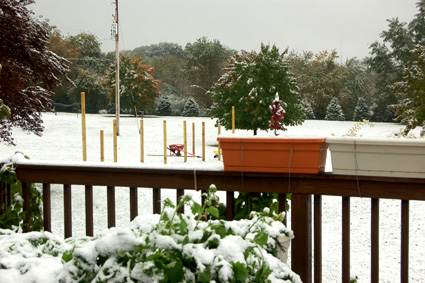
It's snowing here today. Mid-October. As of mere moments ago:

October snow

And we just had our first frost - light enough to spare at least half of the zinnias, even - yesterday morning. Bizarre.

Perhaps this wouldn't be so irritating if I had fewer posts to set on the fence you can see in the background.

04 November 2008

28 October 2008

Halloween horror.

Lewisburg.

We're expecting trick-or-treating munchkins this year, which poses a few problems that we hadn't thought out particularly well before. After all, when you've lived for years inside a locked apartment building with few, if any, small children, these things don't become issues at the forefront of your mind. Halloween focuses more on cobbling together a costume from the nearest thrift store, then stopping to pick up some beer on the way to the party.1 Last year, Sharon picked up some candy at CVS, sort of last-minute, to give out to the handful of kids who stopped by, but that was as far as we got.

(Apparently - even though I missed it - the 3- or 4-year-old in a lion costume who stopped by was the event of the evening. He didn't remember to say "trick or treat" and wasn't sure what to do after receiving his candy. So he just sat down on the porch, looking up at Sharon, until his mother coaxed him down. Our neighbors thought he was adorably hilarious, too.)

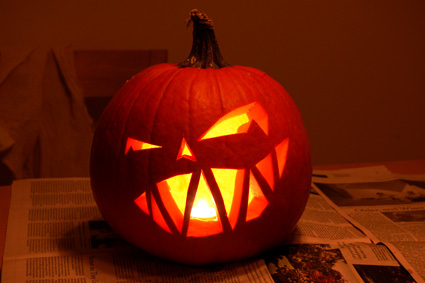
This year, we've expanded a bit. Sharon went to the little candy shop downtown to pick up some treats that aren't HFCS-based. Sure, they're still loaded with sugar - they look like un-crooked candy canes to me, so they've got to be 98% sugar, minimum - but at least it's supporting a local business. And we brought home a pumpkin from the market for the first jack o'lantern either of us has made for years. It was tough, actually, trying to figure out what to carve, when we hadn't done this for so long. So, after a lot of scribbling on little pieces of paper:

Jack o lantern 1

Unilluminated, it's not the most exciting of pumpkins. Having hacked away with the paring knife, though, it isn't as though I could go back and erase, so we dropped in a candle, dimmed the lights, and were pleasantly surprised. Seriously. I neglected to take a candle-less photo, but you'll have to trust me that it was about as unimpressive as it could be.

Even better, though, is when we turned out all of the kitchen lights:

Jack o lantern 2

Good enough for government work, as my dad might say. Which, of course, reminds me that the scariest day of the coming week isn't Friday. It's Tuesday.2

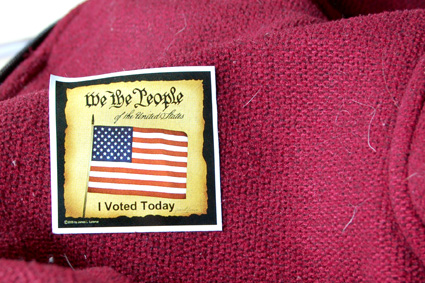
I recommend a regular dose of FiveThirtyEight to take the edge off. Polls, of course, are inherently limited, but aside from knowing my polling place - and a little volunteer time for the GOTV effort - there's little I can effectively do. It's frightening to see the massive, clanging, somewhat-irrational-and-unpredictable behemoth that is the presidential election screeching and howling into election day.

Maybe I should dress up as the electoral college.

* * * * *

1There aren't as many parties to attend, now that we're in central PA, playing the "responsible adult" game, so costumes aren't happening for 2008.a But Fiend Without A Face should be arriving before Friday, so at least we have something horror-related to watch. That's safe to have on when a 4-year-old comes to the door.

My initial thoughts were to watch something more like Dead Ringers or The Act of Seeing with One’s Own Eyes, but neither of those is remotely appropriate for a television that can be seen from the porch.

aBesides that, what am I going to dress up as? The current Republican ticket's the scariest thing I can think of. Aside from some sort of terrible, world destroying Cheney-zilla. (Maybe next year.)

2Why Tuesday? Indeed.

30 June 2008

Daisy.

Lewisburg.

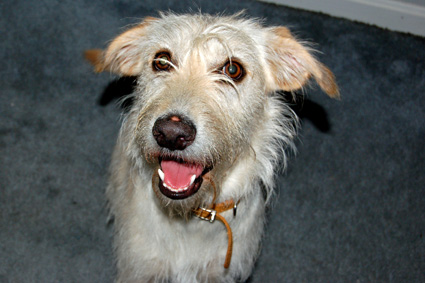
We have a new friend hanging about the house these days:

Daisy

This is Daisy. She's a yellow lab/terrier mix (we think) who came home with us from the Centre County PAWS shelter in State College yesterday. Her goal in life, as near as we can tell, is to be your bestest friend ever. Doesn't matter who you are. Especially if you're willing to rub her belly.

22 May 2008

The backyard.

Lewisburg.

In between the rain showers and gusts of wind, I took advantage of the sunshine to take an amble about the backyard. Among today's interesting sights:

Red peony

The bright red peonies that, one weekend, burst forth from what had looked like an odd, grassless patch behind the deck. And, hiding in the grass near the blueberry bushes:

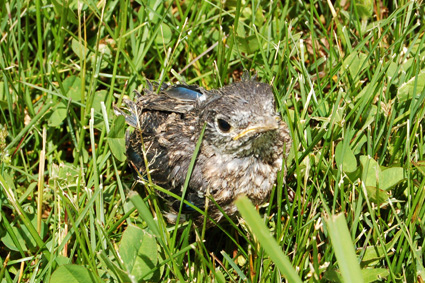
Little bluebird

A young bluebird, just learning to fly. I'd known that its parents were comfortably nested in the bluebird box, and today's the first day I've seen the female in quite some time. As she and her mate made every attempt to lure me away from the young 'un.

21 March 2008

Is it Spring yet?

Lewisburg.

My plate has been rather full of late. And everything, it seems, is food-related these days.

It's been about two months' worth of shuffling things about, but we now have a local Slow Food convivium - Slow Food Susquehanna River Valleys. It's a long and clumsy name, I know, but it's the best compromise we could reach with the head office in New York.1 This, of course, means lots of paperwork to get it all set up, from the Employer Identification Number to the 501(c)3 non-profit status. It's not hard, really. It's just a lot of IRS fine print and more work for our little printer than it's seen since we moved here.

The major upside of this, as far as I'm concerned, is that I get to do neat food-related stuff that I wouldn't get to all by myself. Example: a tour of the Selin's Grove Brewing Company. It's a very small brewery, which means it was pretty much like touring the world's most amazing homebrew setup. Sure, all of the equipment was enormous, but it was all set up inside a renovated garage, and I knew exactly how each step worked. Plus, Steve has to do just about all of it by hand, which sounds rather familiar.

The tour finished up with a tasting of seven of the beers on tap. I can't remember all of them now, but even in those little glasses it was a hell of lot of beer for a Sunday lunch. I'm not saying I'd want to do it very weekend, but it was a grand time.

Then there's the baking class, which I've already mentioned. And the garden planning, which is going full-tilt in preparation for the first seeds to hit soil in just over a week. Or maybe this afternoon, since I forgot to add the herbs into the spreadsheet. Granted, I'm still scratching my head a bit over the last little bits - particularly the lettuce and other greens - but I'm sure it'll work out. I'm sure I'll be giving away and/or composting a wide variety of excess produce, and hopefully taking enough notes to fine-tune it all a bit for next year.

And, coming up soon, I'll be managing our local growers' market. At least that doesn't start until May...

* * * * *

1This after I had to make an impassioned plea to keep the word "Susquehanna" in our name. Lose that geographic descriptor, and folks 'round here won't claim to have anything else in common.

31 August 2007

Tomato de Bergerac.

Lewisburg.

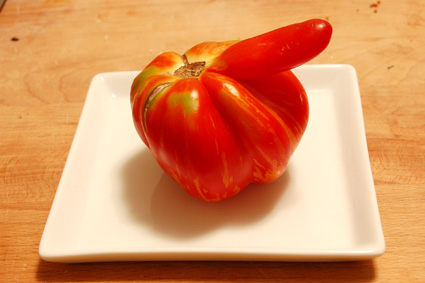
I picked a tomato the other day, and I'm quite sure it's the oddest one I've ever seen. Add a pair of little plastic eyes, and it'd belong in a Joost Elffers book.

Striped Cavern

It might be a nose. Sharon insists it's flipping her the bird. I'm sure the imagination delights in finding anatomical correlations.

Incidentally, the variety is called Striped Cavern. They're a great stuffing tomato, being virtually empty - at least a third air space before coring and deseeding - inside; the flesh is sturdy, too, and holds up quite well in the oven. The flavor's nothing special, so I wouldn't include it in a Caprese salad, but they're still leagues better than any picked-unripe grocery store tomato.

23 January 2007

East Meets West.

Remember that scene, at the end of The Good, The Bad, and The Ugly, where Blondie says to Tuco:
"There are two types of people in this world: those with loaded guns, and those who dig. You dig."
Damn, but we do love a good Spaghetti Western, especially if it's Sergio Leone. The juxtaposition of wide, panoramic desert vistas with super-tight closeups; the cross, double-cross, triple-cross cribbed from detective noir; the weatherbeaten, sunworn faces you'd never see in a today's mainstream Hollywood; Clint Eastwood's short, black cigars. Style.

Same goes for Zhang Yimou, with his beautifully shot films, like Hero and House of Flying Daggers, or Ang Lee's Crouching Tiger, Hidden Dragon. Martial arts and wire acrobatics with amazing cinematography. And choreography.

So we got to thinking. It's not long until the Lunar New Year, which qualifies as a good enough excuse for a party if we ever heard of one. And we started thinking about movies.

In particular, Shanghai Noon. The Jackie Chan / Owen Wilson Hong Kong cinema-meets-Western cliche movie. You know, the one where Jackie Chan kicks ass with a horseshoe on a rope? And Owen Wilson plays, well, that character he plays in every comedy? (It's not the movie with the sweet "Singin' In The Rain" bit. That's the sequel.)

Being indecisive, we've decided to just mash it all together into one grand East Meets West Party. Far East. Wild West. It's not like it hasn't been tried before. It's a cocktail party, a costume party, and a general excuse for a mass get-together.

We're asking everyone to please bring along something 'east' or something 'west'. Food or drink. Whatever. Creativity's a bonus. If you know what you're bringing, leave a comment so we don't end up with a dozen plates of egg rolls.

Unless, of course, you really, really want to bring a dozen plates of egg rolls.

We're insisting that everyone show up in costume. No costume, no soup for you. Again, either 'east' or 'west'. And a great costume means you get a gold star!

To get it started, we'll have some food and drinks along the lines of:
  • Vegetarian stuffed wontons
  • Bison chili
  • Cornbread muffins
  • Sake
  • Ginger iced tea
  • Bourbon
  • Sarsaparilla

Night lights.

Madison.

I flew in from DC last night, via Detroit, and witnessed something absolutely fascinating I'd never had the opportunity to see before. Nearing eight at night, with cloudy skies, I hadn't expected to see much of anything through the window. Lake Michigan, which accounted for a significant portion of the flight, was nothing more than an endless expanse of vaguely discernable cloud cover. It was only when we crossed over the shoreline that things became interesting.

The cloud cover was low, a thin yet opaque veil of cottony puffs that stretched to the horizon. With the ground covered in several inches of freshly fallen snow, all of the nighttime lighting reflected off of the ground, diffusing through the clouds to create patches of light. Milwaukee, off to the south, was brightly orange from the high-pressure sodium lamps; other patches were smaller, isolated spots of cold, metal halide white, sodium orange, or some blend of the two. It was, in essence, a distilled map of nighttime life throughout Wisconsin.

The light barely managed to fight through the cloud cover, revealing a veining of pale light through the dips and valleys. Each spot looked like a snapshot of lightning buried inside the cloud, with an eerie inversion of the usual light and shadow that gave it impression of a film negative: instantly recognizable, but somehow feeling wrong.

I could begin to read the map as we flew home. Milwaukee, far brighter than anyplace else, with distant sparks arcing into the sky as the night's last flights took to the air. Scattered patches heading west, of little towns and shopping centers. And finally Madison, so much larger than anything else around it, with two dimples of shadow over Mendota and Monona.

29 August 2006

Buck Rogers bicycles.

Chicago.

In an interesting1 new development in food science, scientists have developed a way to use bacteriophage viruses to keep lunch meat fresh. More specifically, they're using phages to destroy Listeria monocytogenes, which is not the sort of thing you want in your food. The upside is that there will be less potential for food poisoning from Listeria; the downside is that there could be some unintended consequences, like breeding resistant strains of the bacterium. The researchers claim that using a "cocktail" of several strains of phages will kill off all of the bacteria - meaning there'll be none left to evolve into anything more dangerous. How true that may be, no one knows.

Of course, this also means there could be a new ingredient to add to the end of the list for sliced meat products: "bacteriophage preparation". Well, it doesn't sound as terrifying as some of the other things2 that show up in processed foods. I mean, it's not as though everyone isn't covered in billions3 of phages right now, all doing whatever it is that viruses do to pass the time. If you're happily noshing at Subway on a regular basis, none of this can be any scarier than what's already a normal meal.

Speaking of eyebrow-raising human ingenuity, an LA Times article on human-powered vehicle (HPV) racing is well worth the read. It's a geek sport, a combination of engineering know-how, cycling skill, and no shortage of beyond-all-good-sense dedication. What about that combination isn't fascinating?

If that doesn't sound thrilling enough, consider these tidbits: the sport consists of bicycles that race at fifty-five miles per hour and above; the aerodynamic enclosures look like something out of Buck Rogers; and sometimes, in that desperate lunge for better speed, riders pedal vehicles without windshields, using cameras and video screens. These "camera bikes" have a strong tendency to crash and run objects over, since it's maddeningly difficult to steer a bicycle using a TV. Then again, the European speed record holder4 rides backwards and watches the course through a mirror.

And cable television hasn't turned this into a reality show yet?

* * * * *

1Meaning that I don't know if this is a good thing or a bad thing.

2Sodium stearol lactylate, anyone? How about some partially de-fatted cooked beef fatty tissue? Or, perhaps, a little mechanically separated meat? Okay, I'm done being gross now.

3Or maybe trillions. I have no idea. I'm just sure that the number involves many, many zeroes.

4Damjam Zabovnik, from Slovenia. 73 mph.

28 August 2006

Beetles, The Tick, and more...

Chicago.

Well, the pests have triumphed in the garden. Mexican bean beetles have pretty much trashed all of the bean plants1. And not just ours; plants in all of the nearby plots have been reduced to leafless twigs. It's depressing, in no small part because I really enjoy having a good harvest of dried beans to tide me through the winter. There may be enough on the plants already for a few meals, but nothing like the haul I could have expected in a good year. I guess it's because they're so labor-intensive, but I haven't found many at the market come autumn. Quality, yes. Quantity, no.

I'll admit to a bit of an unusual love of beans, especially dried ones. No one else I know adores them to the degree I do. Not Sharon, my family, her family, our friends... but I'm okay with that. They're delicious, nigh invulnerable2, and all sorts of nutritious. The cooking time can be a downside, but a Crock-Pot or slow simmer in the oven - think Boston baked beans - takes care of that.

Shell beans are also good, but they aren't available for long, or from too many vendors. Like fresh peas, they're such a short-season treat that I tend to use them right away, and in the same sorts of simple dishes. Blanch, add some bacon, toss with pasta, add a bit of cheese. That sort of thing, where it's a mix of a few simple flavors and near-instant gratification.

Also in that category, enjoyed this past week: ripe blackberries; cheese-and-herb-stuffed fried squash blossoms3; sungold tomatoes right off the vine. Upcoming: raspberries, raspberries, raspberries.4

* * * * *

1This isn't the first time Eagle Heights has had a serious infestation. 25 years ago, when I was just a wee tyke, gardeners had all but given up on beans. Note to self for future gardening endeavors: look up sources for Pediobius foveolatus.

2Like the Tick. The big, blue superhero parody by Ben Edlund, who had both a short-lived cartoon series and an even-shorter-lived live-action series. But now - or, to be more specific, tomorrow - The Tick vs. Season One is finally available on DVD. "Spoon!"a, indeed. Or, even better - though it's part of another season - is the line from "Little Wooden Boy and the Belly of Love": "You can't fight crime with a macaroni duck!"b

I guess you had to be there. This was the episode where, in addition to the usual absurdities, we watched the Tick carve Little Wooden Boy from a two-by-four, a giant whale run cross-country, and Tick and Arthur get eaten by said whale. It also includes the linec "Isn't sanity a one-trick pony anyway? All you get is one trick: rational thinking! But when you're good and crazy... hoo hoo hoo! The sky's the limit!"

Which leads me to the always-enjoyable world of Fanatical Apathy, Adam Felber's satirical blog. As mentioned on the latest Wait Wait... Don't Tell Me! - listen to the Opening Panel Round - there's a new definition in the Urban Dictionary. A special sort of off-your-gourd, madcap optimism termed Katherine Harris crazy. Adam took this further in his latest riff on her wildly irrational antics.

When then leads to the reader comments. One of which points out a University of Minnesota study that finds atheists are the least-trusted minority in America. While I'm busy quoting cartoons, this calls for a line from Dr. Zoidberg: "Hooray! People are paying attention to me!"d These days, to be ranked lower than homosexuals means society's definitely decided you're hate-worthy. Half of America may not like homosexuality, but atheism's linked to "an array of moral indiscretions ranging from criminal behavior to rampant materialism and cultural elitism." 'Cause if I had to pick three phrases to best describe myself, that'd be them.

Man, it's good they didn't add in some additional gradations for Marx- and Nietzsche-sympathizerse, 'cause I'd be on the bottom of the bottom of the pile.f Okay, well, a smidge above my gay twin, but that's really picking nits.

aThe Tick's battle cry. The whole show's an exercise in joyful absurdity, so it's best to just accept the craziness and laugh.

bYou see, it was crafts night, Arthur had a date with Carmelita, and... oh, never mind. I swear it's funny in context.

cThis is one of those "lessons learned" lines that always came at the end of cheesy action cartoonsi, except that the Tick's make little to no sense. Like public service announcements as performed by Dadaists.

iIn the G.I. Joe cartoons, it was whatever preceded "Now you know, and knowing is half the battle!" The other half apparently involved color-coded lasers, explosions, and no one getting hurt. G.I. Joe: it's like our very own Bizarro world!

dLike when he said it, it's only funny because it's definitely not good.

eI pick Marx and Nietzsche because I've been reading Camus lately, and a bit caught my eye in The Rebel: he comments, with an anger and bitterness rarely seen in his writing, on how the Nazis and the Stalinists destroyed - at least in the popular mind - the brilliant philosophical work of these particular men, by bastardizing their ideas, taking the bits and pieces that suited them and applying just those. Like executive power with no checks and balances. Or religion (any one - and I should include the "lack of religion" groups here: the atheists, the agnostics, and all the subtle variationsi therein - or just call it "belief system") once it strays from rational thinking and moderation.

i(Man, we're deep in footnote-land here.) This, in part, is why there aren't a whole lot of well-known, organized atheist groups. There is one in the military, which, of all the major facets of American society, could very well be the least tolerant of diversity. Another reason, I think, is that people tend to get together over something they have in common. Not a lack of something. Atheists have other interests that keep them occupied, and tend to band together in reaction. Not action.

fBut, on the upside, I'm a "minority", something I'd never realized. I may not be a beautiful and unique snowflake, but I'm a lot closer than I'd realized. For what that's worth.


3Okay, so they take a little work, but they're fantastic, and when The Joy of Cooking says, "Serve right away", it's no joke. They're at perfection at that moment when they've just cooled enough that you don't burn the roof of your mouth.

4Red, orange and yellow, the raspberry rainbow available from Blue Skies. No blacks there, though. I'll have to ask why. They were the wild raspberry of my childhood.

07 August 2006

Jesse & Regina - married at last.

Madison.

Aaand... the last wedding of the summer is finally over. Jesse and Regina had their wedding last night, and it was a pleasure and a relief for everyone involved. A pleasure for the obvious reasons. A relief because all the planning and work is over, and everything seems to have gone right. Now they get to gear up for moving day, the annual Madison tradition.

I admit that I'm not too sorry that I'll be out of town.

There were a fair number of lessons to learn last night, as well as some interesting (and funny) moments. Such as:
  • When planning an outdoor wedding, it's good to be sure that your indoor facilities can accommodate comfortably in case of inclement weather. Fortunately, this worked out. Given the morning's gradual shift from thunderstorms and downpours to eventual sunshine, the set-up crew just put everything inside. Good weather rolled in for the festivities - and the photographs beforehand - but the ceremony and reception stayed indoors.

  • When planning to use Olin-Turville Park for your next outing, be sure to see what's going on over at the Alliant Energy Center. If it's an outdoor concert featuring a series of loud, whiny, not-particularly-talented pseudo-metal1 bands, you may wish to find an alternate date. If that's not an option, your best bet is to shut the windows along the pavilion's west side and hope for a sudden, inexplicable generator failure to force the bands to play intimate, acoustic sets.

  • The farmers' market is the place to get flowers. Though enormous - and necessitating the occasional shift to see the person across the table - the bouquets were eruptions of brilliant color, and a lively counterpoint to the all-white interior of the pavilion. I can't recall who provided them, except that he was Hmong and no one was sure how to spell his name.

  • You can't get New Glarus beer in Minneapolis. John Neely laments this sad state of affairs. He's asked around, and it seems the only way to enjoy some Fat Squirrel in the twin cities is to haul it from Madison yourself.

  • Good roast beef doesn't take much, and it will get you no end of praise. People kept complimenting Sharon and I on the food, to which I had to respond along the following lines:

    • Telling us that we'd prepared a wonderful buffet: "Thanks, but we only made a portion of it. It was a team effort." This then prompted either a comment along that suggested we were too modest or one on something specific. Usually the roast beef.

    • Commenting that I ought to consider a catering business: "Maybe one of these days. Thanks." Sounds tempting as a vaguely defined enterprise, but I don't think I have the chops for it.

    • Gushing about the roast beef: "You can thank John and Dorothy. They raised the animal. I just heated it."

    On that point, Neely mused on something that he'd heard somewhere recently. "You don't cook a good steak; you source a good steak."

    I had to agree. Neely's point was that the quality of a steak depends almost exclusively on the animal it came from, especially since we tend to do little more to a good steak than add some salt and pepper before tossing it on the grill. Unless you do something to ruin it, you're looking at a piece of meat that's only as good as the animal it came from. And, since few of us have the opportunity to know the animals we're eating, it's best to learn who you can rely on to provide you with consistently good food. The top choice would be a good farmer or rancher; failing that, look for a good butcher shop.

    Incidentally, the beef was amazingly good. I was a little wary of cooking it a day ahead and serving it cold, but the flavor, texture, and appearance were still top-notch. The slow-roasting process - somewhere between four and five hours - produced slices that were well-done on just the thinnest outer layer2, but a lovely medium-rare red throughout. Slicing the next day, they were still good and juicy. (Time to make a note to include that in my future entertaining repertoire.)

  • Speaking of food, the glories of the cold buffet on a hot summer day are not to be overlooked. Not only can everything be prepared ahead of time and kept on ice, but I wouldn't have wanted to eat anything hot. I even opted for beer over wine because there was more of it and it was colder. If we'd had any way to serve ice cream, we'd have been hailed as heroes.

  • Jesse and Regina - with help from friends and family, but virtually no professionals - planned out the whole wedding. Just about everything reflected their individual tastes and personalities, and I feel that made it one of the most exciting and fun weddings I've ever been to. One of the biggest perks, I think was that everyone was willing to lend a hand at all times, knowing how much stress and trouble the whole process had been up until that point. We stuck around until the very end, cleaning and packing up, and there were plenty of helpers.

  • Ord, Regina's mom, has a few photos of the last few of us, taking the last swigs from the open wine bottles before we poured them out. That moment summed up the whole day, as we toasted the happy couple3 to celebrate the success of the whole endeavor. It was the triumph of a kind of homespun happiness over the traditional, expected elegance.
* * * * *

1Real metal isn't angsty. There's never any assurance that it's good - I'll wager that most is pretty much just schlock - but distortion pedals and big amps do not a metal band make. Just like having tattoos and using power chords doesn't make you punk. Pop-punk is just pop.

Punk is the Minutemen recording in after-hours sessions after practicing all day, on used tape, so their albums would actually make money. For example.

2From the initial searing, to get a little of that Maillard flavor.

3Long gone, of course.

03 August 2006

This Is the Face of California Farming.

Chicago.

Yesterday's Los Angeles Times noted an interesting new ad campaign in Santa Monica. To celebrate the 25th anniversary of the Santa Monica Farmers Market, the city is plastering buses with the images of their local farmers, using the tagline "This Is the Face of California Farming." They may even be producing a booklet containing the best of the fifty photographs taken.

13 July 2006

The Battle of Downingtown?

Madison.

It's not often that one's hometown gets mocked on NPR, so I find it well worth pointing out. Even if it did occur on Wait Wait, Don't Tell Me! nearly four years ago. "Bluff The Listener," specifically. Adam Felber does mispronounce Downingtown as Downington, but he's far from the first. A lot of people seem to have trouble seeing that w at the end.

In case you're wondering where this misguided blip off the Pennsylvania Turnpike is, here's a map. If you're into bogus history, it sounds like Downingtown's the place to be.

12 July 2006

On gin and laudanum.

Madison.

I'm ever so cheered to see folks rooting for the gin martini. There's even a point - albeit small - scored for vermouth. Then again, I spent much of college drinking sweet vermouth, on the rocks with a twist1, as an after-dinner drink. Dry vermouth's a bit much for regular drinking, but if you don't like it, don't order a martini. Ask for gin or vodka, straight-up. Most bartenders don't care what sort of glass you want it in, and it's not like they're keeping tabs on the number of olives left in the jar.

Sometimes I feel like a college indie kid again. Yes, I want good gin to be popular enough that I can be assured of finding it in liquor stores and bars, but I don't want it to be so popular that I feel silly ordering it. Then again, I'm fully creeped out by the notion of sugary-sweet "martinis," those of the chocolate, or raspberry, or whatever persuasion. Couldn't they have latched onto some moniker that wasn't something I genuinely like?

Oh, I'll just get it out of my system. As far as I'm concerned, there should be several ground rules for the martini:
  • A martini requires gin. If it's made with vodka, it's a vodka martini. You can't make a margarita with rum or vodka or bourbon, at least not without pointing that out ahead of time.

  • A martini requires a significant portion of vermouth. Dry, preferably one-sixth to one-quarter, so you can actually taste it. This may depend on your preferred gin and vermouth.

  • The only sweet drink you can call a martini is a sweet martini, which swaps out the dry vermouth for sweet. Garnish with a strip of orange peel rather than an olive. Still gotta be gin.

  • Anything hewing close to the martini recipe - gin + dry vermouth - can be called a martini, but only when its name spells out the modification. For example, a dirty martini gets a little olive brine added in, if that's your thing.

  • The Gibson is cool enough to have its own, un-messed-with name. You may not fiddle with the Gibson as you would the martini. Something has to be preserved.
But enough about booze. What's more exciting? Opium!

Yeah, opium. As in, that very pretty flower that can get you stoned out of your mind if properly prepared. You can grow this at home, assuming you don't know that you can use it to make illicit drugs. If you do know, growing it is illegal. If you just think they're nice flowers - and they really are - you're probably okay.

Sound crazy? Take the time to read Michael Pollan's 1997 article on the subject. It's all sorts of maddening.

The high points, as I recall them:
  • The seeds of "opium poppies" - primarily Papaver somniferum, among other poppy species - are readily available from gardening catalogs. Also from the spice section of your average grocery store. Perhaps on bagels, but I'd expect they might have trouble germinating after being baked.

  • Seeds: legal. Plant: possibly legal, possibly not, depending on how many you have, how much you know, and who's asking. Seedpod sap and other extracts: all sorts of illegal.

  • You want to buy some really out-there books? Until recently, the go-to place was Loompanics Unlimited. If no one else was willing to publish your book on, well, just about anything, Loompanics was the publisher of choice.

  • Opium tea is a standard thing at certain Middle Eastern funerals2. Marijuana is also perfectly acceptable in many cultures in that part of the world. Alcohol, though... not a chance. I guess you pick your poison.3

  • Despite what some would have you believe, it's entirely possible to cultivate poppies in places other than southeast Asia. You can grow them here in Wisconsin, although I'd suppose illicit drug manufacture would require a suspiciously large flower garden.

  • The Bill of Rights doesn't seem to apply in drug cases. You know, that whole "due process" thing? Get caught doing something illegal and drug-related in your home, and the authorities can seize your house, land, etc., then sell or use them as they see fit. Regardless of whether or not you're ultimately convicted of any crime. If you rent, you can be evicted, again, without actually being found guilty of a crime. Or even charged. Fun, huh?

  • Opium sap is fiercely bitter. Add this one to the list of consumables that it's hard to imagine anyone discovering in the first place.4

  • Rational behavior does not seem to come naturally to the drug enforcement authorities in this country. Or to drug-related taboos in just about any culture, anywhere, anytime. I quote Pollan, because it's hard to paraphrase his summary:
    The war on drugs is in truth a war on some drugs, their enemy status the result of historical accident, cultural prejudice, and institutional imperative. The taxonomy on behalf of which this war is being fought would be difficult to explain to an extraterrestrial, or even a farmer like Matyas. Is it the quality of addictiveness that renders a substance illicit? Not in the case of tobacco, which I am free to grow in this garden. Curiously, the current campaign against tobacco dwells less on cigarettes' addictiveness than on their threat to our health. So is it toxicity that renders a substance a public menace? Well, my garden is full of plants—datura and euphorbia, castor beans, and even the stems of my rhubarb—that would sicken and possibly kill me if I ingested them, but the government trusts me to be careful. Is it, then, the prospect of pleasure—of "recreational use"—that puts a substance beyond the pale? Not in the case of alcohol: I can legally produce wine or hard cider or beer from my garden for my personal use (though there are regulations governing its distribution to others). So could it be a drug's "mind-altering" properties that make it evil? Certainly not in the case of Prozac, a drug that, much like opium, mimics chemical compounds manufactured in the brain.
  • My favorite nugget of ironic humor: many of the hatchet-wielding hardliners of the Women's Christian Temperance Union were said to unwind at the end of a long day with their "women's tonics." Primary ingredient: laudanum, also known as tincture of opium. An alcoholic extract of the opium poppy. I find that all sorts of funny.
Suffice to say, I probably won't be growing poppies anytime soon.

Incidentally, my personal favorite high is from chillis. Eating enough seriously spicy food will get you feeling very, very good, presumably from all the endorphins the brain's pumping out to deal with the onslaught of capsaicin.5 Just thought I'd share.

* * * * *

1Yeah, the drink from Groundhog Day. Benefits for college students of legal drinking age: is perfectly drinkable at low prices, unlike wine; keeps indefinitelya and is ready-to-drink at room temperature, unlike beer; won't get you too intoxicated to do something useful, should you feel like it, unlike spiritsb.

aRelatively, anyways. It's not like we were saving this for special occasions.

bScotch is lovely and all, but I consider my evening effectively complete by the time I sit down with a glass.

2Opiates are powerful painkillers, true, but they also help eliminate depression. Though I can't substantiate it, I've heard that morphine works, not by reducing pain, but by making you no longer care. If the pain exists, but you're completely non-plussed about it, you might as well not have any.

Then again, you could have the great fun of withdrawal in your future. Whee!

3Or, rather, your culture and associated law-enforcement bodies pick it for you.

4Also: coffee, chocolate, huitlacoche, other delicious mushrooms that look a lot like poisonous ones, and so on.

5The accompanying beer to mediate the burn doesn't hurt.

27 June 2006

Behold: Fanny the Roborat.

Chicago.

Hooray! Fanatical Apathy got an upgrade! Or a facelift. Well, it's something snazzy-looking.

Best of all? Adam Felber's added in a few other bloggers, including Mo Rocca and Fanny Roborat. Fanny would be the official FA mascot, as inspired by this story of science gone mad. Seriously. This is like some kind of B-movie setup. The next step, I think, involves massive amounts of radioactivity1, resulting in giant monster robot rats that destroy much of downtown Akron before pseudoscience saves the day. Or possibly Godzilla. He hasn't been around much lately, though.

And speaking of city-smashing excitement, I finally got around to seeing The Incredibles this past weekend. It's a shame Brad Bird hasn't directed more throughout his career - even his stint on "The Simpsons" was primarily as a creative consultant - because he does such wonderful work. Moreso than the previous Pixar features, this felt like a complete film.

Not that the others2 weren't wonderful, but they felt like kids' movies brought up to a level of sophistication where adults could enjoy it. The Incredibles felt more like a movie intended for adults, but which happened to be just fine for kids. Issues that wouldn't mean much to young'uns - like marital infidelity - are touched on in more subtle ways that zip over their little heads. And the usual superhero clichés were tweaked or contrasted so wonderfully with the mundanity of real life, and it was genuinely a relief from the big, mindless action flicks.

Among the points that cheered me the most:
  • The juxtaposition of the super and the mundane. Bob's and Helen's problems require the same sort of gentle relationship maintenance as anyone else, regardless of their crime-fighting superpowers. Bob's put on a lot of weight in middle-age, past his glory days, like every ex-football player you've ever seen. And so on.

  • Edna Mode's vehement opposition to superhero capes. Sure, they look snazzy on the comic book cover, but they're pretty silly in most cases. Batman's an exception, but one of the few. And Brad Bird as Edna is just delightful.

  • Superheroes with previous engagements. It's so rare that a superhero just lets the criminal go because he's got something more important (that isn't some other, more impending, world-threatening disaster).

  • Well-chosen voices. No one seemed bigger than their characters, which is the unfortunate norm these days. Until the credits ran, I was expecting (and hoping) that Frozone was voiced by Phil LaMarr. Not that Samuel L. Jackson didn't do a find job, but I'd love to see the real voice talents get bigger roles. But Craig T. Nelson? Sarah Vowell? Excellent, unexpected choices.
* * * * *

1Possibly from outer space.

2Excluding Cars. Haven't seen that yet, so no comment.

30 May 2006

Memorial Day weekend.

Madison.

The long weekend, and now it's back to work. That said, it was one hell of a busy three-day weekend, loaded with all sorts of fun activities.

Saturday
Saturday morning was my first morning working at the DCFM, the farmers' market on the square. Aside from being a beautiful and sunny day, it was a useful learning experience1:
  • Apparently, I know enough of the vendors well enough that no one thought it unusual that I was walking around with the farmers setting up their stands at quarter past six in the morning. I don't know if I should be bothered by this or not. At the very least, it coincides with the fact that Sharon and I tend to get all sorts of free stuff, goodies in short supply hidden under the counter (as it were), etc.2

  • I assume this to be more or less unique to this particular market - due to its size, location, and the fact that everyone mentions it to tourists and out-of-towners - but I noticed very distinct waves of shoppers throughout the morning. A less extreme example of this must occur everywhere, but here's what I witnessed (and, honestly, had sort of expected):

    1. The first wave.3 Since the market is so large, and so well established, there's a distinct hierarchy based on seniority. The longer a vendor's been coming to the market - along with several other factors - the better a location they get. After enough time, they get a fixed location, and can set up their stand at six. The remaining vendors walk around, stake out a spot, then set up half an hour later.

      The shoppers of the first wave make their way around while vendors are still setting up. They're a scattered bunch, and include a number of vendors themselves, like Dorothy Priske. Since she and John can set up their stand earlier, she has a chance to do their shopping before the crowds arrive, an opportunity to chat with the other vendors. All of these folks know exactly what they're looking for. They know who has what, and move along with a speed that's impossible once the crowds form.

    2. The second wave. This is the wave I like to be in. Though these people may not know exactly what they're looking for, they're very open to trying new things. Though they may be specifically hunting lettuce, they'll happily taste a bit of arugula, then probably pick up some to take home. They ask questions, they're interested to know what's new this week and what'll be coming up soon. A fair number of them know that farmers by name, and want to say hello.

    3. The third wave. These folks look as if they're new to the market, and a number probably are. They don't have regular vendors they look for, but slip to the side because they've spotted red-leaf lettuce, or strawberries, or something that looks unusual. New things make them apprehensive, and you can never be sure if they'll actually try the swiss chard. Some will, while others will just set it back down and apologize. "Maybe next week," they'll say.

      At this point, the market has become seriously crowded. You no longer walk around the square at a normal pace, but shuffle and walk in intermittent spurts. Some stands - particularly those with cheese curds - become bottlenecks. The grazers begin to appear: the shoppers who taste samples and never buy. This rubs me the wrong way.

    4. The fourth wave. Here come the tourists. They arrive after all of the best stuff has been sold, though they're the least likely to buy any of it, anyhow. These shoppers are looking more than buying, and tend to frequent the bakeries and cheese stands, in massive hordes. Their numbers swell immensely when another tourist draw is in town: a football game, say. They're likely to be frightened by anything more exotic than lettuce4. It's a little depressing. Those shoppers who overslept, or haven't realized that the best goodies disappear early, get stuck here, and inevitably sigh when we have to tell them we've sold out of various items early on.

      By this time, the crowds can only shuffle past. Severe boredom has set in for some - usually middle-aged men, who appear to have been dragged here by their wives. The "salmon" start becoming a regular feature at this point. To explain: the market crowd moves around the square in a counterclockwise direction, just as the one-way streets that border the capitol run. Trying to go the opposite direction is a slow, tedious process of bobbing and weaving, because the rest of the crowd fills the sidewalk completely.

      Another irritating feature of this wave is their shock at the prices of what we're selling. I don't know how to get through to them that the seemingly cheap food at the supermarket has all sorts of hidden costs - economic, yes, but especially social, environmental. The prices you see at a local market, especially one as large as the DCFM, reflect the actual costs of providing food, of supporting the people who farm the land. They're severely underpaid as is, and to suggest that two dollars is too much for a head of lettuce reflects an uninformed worldview. I'm tempted to be angry at these people - and if it's a particular person who should know better, I am - because they say, through their actions, that my friends don't deserve a decent income, don't deserve to raise their children in a safe, comfortable environment... etc.

      These farmers work harder and longer than virtually anyone else walking around that market, and not a single one of them will ever be wealthy because of it.

  • Being a regular at the market means I've become a good reference point. In the past, I've been asked for a second opinion for a customer at Fountain Prairie or JenEhr Family Farm. Unsure of what to buy, or what to do with it afterwards, some customers like to have a little reassurance, or maybe a different way of using it. That said, the Priskes sent along a customer to find me at the JenEhr stand, which was suprising and hilarious. A young guy - looked like a college senior or recent graduate - and his girlfriend (I'm guessing) bought one of the cured, smoked hog jowls from Fountain Prairie. John and Dorothy sent him over to me, to give him some idea of how he might be able to put it to use.

    He seemed pretty open to suggestions, so I'm pleased. I'm not sure how they got him to buy it in the first place. I think he'll enjoy it.

  • Working with someone cool - Steve, in my case - makes the long morning feel good. It's not like we were chatting all morning long, but we managed to tag-team pretty well, keeping the table stocked, setting up and breaking the stand down with a minimum of fuss. We worked pretty well together, and that made it all run smoothly.

  • Kay trusts me more than I'd expected. From the start, she put me in charge. That included setting up the stand, which seemed like a big step for my first day working with her. It worked well, I think, because I didn't set things up like she normally does on autopilot. (Which is what she wanted me to do.)

    She and Paul like to arrange vegetables in bands of contrasting colors that flow down the display table. (Beneath the tablecloth, we have a set of low crates to give an upper tier at the back.) It's definitely eye-catching, and a good attention-grabber. I tried to do something a little different, with a more fluid layout. Since we didn't have much asparagus, for example, it became an island surrounded by spinach and arugula. As the asparagus disappeared, we filled in that space with the other greens. Since it had never been rigidly linear, this didn't look like a mistake. We also used some colored baskets, set upside down, to lend contrast.

  • Breakfast burritos from A La Cart are excellent. I wholeheartedly recommend.
The other significant thing that happened on Saturday was an eventful trip to Four Star. They've done some serious housecleaning, so I ended up buying four new DVDs: Richard Linklater's Waking Life, George Romero's Dawn of the Dead, David Cronenberg's A History of Violence, and Sam Peckinpah's The Wild Bunch. Violence galore! But (with the possible exception of The Wild Bunch, which I haven't actually seen), these're films that use violence to comment on our society, rather than in your typical action flick - like X3, which I'll get to later.

We also rented Terry Gilliam's The Brothers Grimm, which was enjoyable enough as action/comedy fluff, but rather short on the usual Gilliam-ness. I can only really recall one scene - one shot - which struck me as true Gilliam: Jonathan Pryce, the French general, is greeting his assembled dinner guests, all various dignitaries and such. The camera cuts from a close-up of Pryce to the table of guests, which stretches off to infinity in a monstrously cavernous space, with a perspective that's jarring. Drain it of color, and you'd think he'd clipped this shot from Brazil.

Other than that, it was disappointing. I know there was a lot of Hollywood controversy and a lot of hands in the pot, and it feels that way. Given the premise, and Gilliam's love of fairy tales and the grotesque, there was a lot of potential. Still, if you treat it as a fantastic action film and assume some anonymous director, it's well worth a rental.

Sunday
The weather's been quite warm lately, and with any danger of frost past us, we planted our tomato and pepper seedlings in the garden. Then spent a good hour digging out quackgrass rhizomes that had crept in from the neighboring plot. The next plot over has been rototilled, so I'm pretty sure it'll erupt in quack before the end of the season. It's an insidious weed, filling the garden with its underground root network. Even the littlest piece of that root left in the soil might come back to life.

The worst part - and I'm afraid that our neighbor may run into this - is that you can't get it out if you've got plants in the garden. Tearing out the quack means you'll have to disrupt everything, so you spend the growing season shearing it off at the ground and hoping it doesn't spread.

That night was Nick and Simone's wedding reception. Like Sharon and I, they'd gotten married well before throwing the reception party, so - even though there was a brief renewal of vows - it was essentially a big party. On a farm out in southwest Wisconsin, in the middle of nowhere. Since all wedding receptions share certain cultural references, I'll just point out a few random things:
  • The weather was beautiful, and I can't stop thinking about how lucky we were on that account. Thunderstorms have swept through frequently in the past few days, but not that night. We even had a good, constant breeze from the south (where we could watch a wind farm in the distance) that kept all of us in ties and jackets from keeling over in the summery heat. Once the sun set, it was lovely simply standing out in the night air.

    This is a danger of the outdoor wedding, especially since the planning is done so far ahead of time. I've got to believe that our good fortune was a great relief to Nick's frazzled nerves.

  • Nick's parents brought an alarming quantity of palincă - Romanian plum brandy - from Bucharest. Double-distilled, it's strong stuff. It reminded me a lot of grappa, with a clean flavor with hints of vanilla and nuts, among others. Most didn't care for it, but I enjoyed a little glass.

  • Nick's old roommate and her boyfriend brought a keg of homebrew from Minneapolis. It was a wheat beer, but more like a light, slightly cloudy amber ale than a hefeweizen. It was a wonderfully refreshing cool drink, with such a small amount of hop bitterness that you could probably drink it like iced tea.

  • High beam headlights are a wonderful thing. There's little opportunity to use them here in Madison - and zero in Chicago - so it was a little thrill to be able to flip them on out on the back roads of Iowa County.

  • Nick and Simone, of course, looked like a wonderfully happy couple. No surprise there. Now that the whole thing's past, they can settle back into a much less stressful existence, and that can only be a good thing.
Monday
Memorial Day, and what better reason for a near-impromptu grilling party? Paul Johnson's back in town, that's what.

We didn't think of it until midday Sunday, so no one was really prepared, including us. No matter. We had enough food to grill up burgers, mushrooms and sausages, along with some potatoes. Add in a salad and whatever other odds and ends other folks had - beer, mostly - and we were good to go.

Jared brought along a six-pack of his homebrew batch, and the general consensus was positive. I think it needed a little more hop backbone to it - it was a little sweet - but not bad for a first attempt. Besides, that's not his fault. I could tell from the recipe in the kit that it wouldn't seem like enough to me. But it's certainly drinkable, and good served ice-cold beside the grill, so I doubt those two cases'll last very long.

Paul also brought along a pumpkin pie, to finally fulfill his outstanding obligation to Sharon. Their bet involved some strange and insignificant bit of math arcana, and Paul, in losing, needed to bake Sharon a pie. Addington, whose house he was staying at, happened to have a can of pumpkin and a can of sweetened condensed milk at his place. Thus, they decided to bake a pie. Successfully.

After gorging ourselves and melting in the heat and humidity, a few of us decided to go see a movie. As I have no interest in seeing The Da Vinci Code5, we checked out X-Men: The Last Stand. I'd all read the reviews, and didn't expect much other than a dumb action flick. Expectations adequately met, I guess. It sure didn't seem like it needed the big screen, though, and that's a depressing thought. When you think you'd get as much enjoyment of the eye candy on a TV, that says something's not quite right.

It did make me think, at least. Mostly by omission, rather than by raising significant points, but here goes:
  • The whole allegory of homosexuality pretty much disappeared. There was sort a token veneer of "mutant = racism" or "mutant = homosexuality", but it didn't go anywhere. The only conflict derived from it was used to further the plot. No exploration, no dawdling over characters' feelings, no philosophical discussion. It's not a necessary thing to have, but it's so ripe - in the context of the film, in the context of our current society - that it's shame it's not there.

  • Same goes for character development. There wasn't any. A few miscellaneous scenes hinting at romantic rivalries spliced here and there, but there was no development along those lines. Of all the major comic book series, the ones most of us non-comics folks recognize, X-Men is the most like a soap opera. Where's the melodrama? As it was, it was hard to really care about any of the characters. Any emotional involvement had to carry over from the two previous films.

    A glaring example of this is Angel. He starts out so well - a young boy trying to cut the mutant wings sprouting from his back - then resurfaces for a few very brief moments as a walking cliche. Flips out when he's restrained to have the "cure" injected, then bursts out of the window and onto the winds. He swoops through the air to save his father, falling to his death. He steps into the Xavier Institute to start a new life. Who is this guy? The movie doesn't seem particularly interested in him. He's like a MacGuffin with wings.

    Along the same lines: pretty much all of the mutants Magneto conscripts. Names? Nah, the movie doesn't bother with those. They're mostly special effects pawns. When they die, we don't much care one way or the other.

  • Corny one-liners? Either leave them out, or go whole hog. The two extremes work. Compromise doesn't. The half-assed approach to camp - just like the tepid interpersonal relationships - doesn't cut it.

  • Bizarre logical conclusions. If Juggernaut is so threatening that he needs to be completely immobilized, locked into a closet, and secretly driven around 24/7 in the back of a tractor trailer, why isn't he simply given the mutant "cure"? He's a dangerous psychopath. Even in legal prisons, the law allows inmates to be forcibly medicated for the safety of guards, other inmates and themselves. Regardless of where that might stand ethically, you'd think this would have occurred to somebody at some point. At least to mention, if not act upon.

    And there's another unaddressed issue. Secret, mobile prisons? Come on... you can't pull this stuff from the headlines and just let it hang there!

  • Oh, and the violence. So sterile and neutral. Aside from Wolverine opening up in bloody wounds - which seal up more or less instantly - you don't see much of anything. Even as Wolverine carves up dozens of people, and they immediately fall out of frame. No blood, no screams, no nothing. I guess this is more or less normal for summer action flicks, and I'm just disillusioned with that.

    Or maybe it's because the movie failed to address anything else, so I just started latching on to every omission I could. Before we went to see the movie, I was discussing Cronenberg's A History of Violence, which takes the complete, polar opposite tack. Violence, and its impact through the popular media, was on my mind. I think I was offended by the complete lack of blood. Even if there were some - and it were quickly passed over - I'd've been okay with it.

    Characters who die are simply forgotten. Major ones. Cyclops dies at the beginning of the film, and we essentially hear nothing about him until we see his tombstone at the end. It's crazy.

  • And it was so short - ninety minutes or so. All of the things that this film could have used - character development, social commentary, breathing room between exploding setpieces, etc. - sure weren't trimmed for time.

* * * * *

1And a chance to verify a few of my hunches about the whole thing. That being a primary reason behind my decision to start working at the market.

2For a more intense example, check out the "Lunchtime with the King of Ketchup" on this episode from This American Life. I can only aspire to Howard's level.

3The waves overlap and blend, of course, but the distinction is still pretty apparent when you're standing around, watching and talking through the morning.

4Seriously. Some of them bear a distinctly spooked expression when you try to explain that mizuna makes a great salad green. They'll pick up unfamiliar produce as though it were something potentially dangerous, like a live animal.

5Don't want to read the book. Don't want to see the movie. There're enough other books and films I'd like to see that have a much better claim to my time and money. It's not like I'm missing some grand cultural edifice; I mean, this is the sort of pulp drivel you'd expect to churn out for NaNoWriMo or something equally silly and amusingly self-absorbing.

16 May 2006

Preliminary thoughts on growth.

Madison.

At some point during last year's NaNoWriMo1, Chris Baty mentioned - in one of his amusing, coffee-fueled pep talks - Bruce Mau's2 "An Incomplete Manifesto for Growth" as an inspirational reference point. It reads a lot like those cheesy, oft-forwarded email lists that I always ignore, but feels like the product of experience and critical thinking, rather than the vapid filler of Hallmark cards.

Mostly, anyways. A few that strike me as worthy of further consideration:

2. Forget about good. Good is a known quantity. Good is what we all agree on. Growth is not necessarily good. Growth is an exploration of unlit recesses that may or may not yield to our research. As long as you stick to good you'll never have real growth.

Maybe this was just how he thought eight years ago, but good no longer appears to be what we all agree on. Nor, as corollary to that, a "known quantity." It is, I believe, a highly subjective matter, but that's not what I'm getting at.

I'm concerned about growth because of the vagueness of it. I like to think that Mau is referring to development, to evolution, rather than to the process of enlarging. Given his design focus, this would make sense, but it's not clear. Especially given the way capitalism seems to work - the Wal-Mart effect - by rewarding bulk and power; this sort of growth abandons good. To foster growth at the expense of good, with no system to balance it, is dangerous. We need to retain the ability to rein in growth that has become harmful.

14. Don’t be cool. Cool is conservative fear dressed in black. Free yourself from limits of this sort.

I really like this one, especially coming from a man whose own life's work is deeply rooted in style. I've never had much of a knack for cool. In the design world, cool often supplants good sense, and it's always irritating.

That said, I don't have much to add. I think there's a crucial difference between those who are cool because they're pioneers, being bold and different - the minority - and those who are cool because they're mimics. The difference is that the former aren't trying to be cool; they're evolving and have the confidence to pull it off. It's not always a good thing. Sometimes it's naught but fluff and style. But it beats being a stylistic copycat.

22. Make your own tools. Hybridize your tools in order to build unique things. Even simple tools that are your own can yield entirely new avenues of exploration. Remember, tools amplify our capacities, so even a small tool can make a big difference.

The key point here, I think, is that tools "amplify our capacities." This is not the same as an object we use to complete a certain task - which seems to be the common perception of a tool - but there is some overlap. I think our understanding of the role of tools, of technology, is better informed by this notion of amplification.

We use tools, especially specialized ones - think pneumatic nail guns, or lawnmowers - to accomplish certain specific tasks. Tasks that we can't do without them, at least in quite the same way. In a practical, mechanical sense, they simply redirect our energy into forms and directions our fingers can't manage. In a design sense, tools are objects or processes that enable us to bring an abstract vision closer to reality. Or that reality closer to our initial conception of it. In either sense, tools are simply "finglongers" for our skills and abilities.

Mau also notes that we should "hybridize" to create something unique. This is like a feedback loop through the tool, using our skills to enhance the tools to further develop our abilities. I think we forget this, but more on that under the next note.

29. Think with your mind. Forget technology. Creativity is not device-dependent.

I don't think we should forget technology, but that we should learn to avoid relying on it. In particular, I think it's dangerous to rely on technologies that we don't fully understand - computers and cell phones come to mind, as both poorly understood and ubiquitous. When technology is a black box, placing our well-being in it is a remarkable leap of faith, and one that most of us do every day.3

I'm not advocating Luddism, in the sense of declaring all technology evil, of reverting to some benchmark in human history. The short and brutal existence of stone-age man (or of the Renaissance, or whatever), stripped of any romantic sheen, has all of zero appeal. But if you were only permitted to use a cell phone, or a microwave, after you were able to understand how it works? It's not difficult, and it makes such a difference in how someone uses that tool, in respect for the technology. In using it in the way it's supposed to work. In, as Mau puts it, hybridizing the tool to extend its, and our, capabilities.

In the same vein, I think that we need to better understand the networks, the systems that support us. Consider Michael Pollan and his attempts to trace a McDonald's meal back to its source, and his point - and not his alone - that cheap food is remarkably expensive, in ways that aren't easily quantifiable in dollars. Consider the American dependency on foreign oil, and its connections with terrorism, human rights violations, etc. Not knowing these things - not attempting to know these things - puts us in the position of being at the mercy of the black box.

Freedom equals responsibility. We all know this.

33. Take field trips. The bandwidth of the world is greater than that of your TV set, or the Internet, or even a totally immersive, interactive, dynamically rendered, object-oriented, real-time, computer graphic–simulated environment.

"But this is HDTV! It's got better resolution than the real world."

It's so obvious, and yet...

What Mau doesn't say, directly, is not to simply get out and see the real world, but to pay attention. Look at the details, the subtle changes and differences in the world around us. The level of detail out there is always more than we can fully understand. You can't look too hard, too close.

35. Imitate. Don’t be shy about it. Try to get as close as you can. You'll never get all the way, and the separation might be truly remarkable. We have only to look to Richard Hamilton and his version of Marcel Duchamp’s large glass to see how rich, discredited, and underused imitation is as a technique.

Imitation rocks. Seriously.

The clearest example of this, to me, is cooking-related, but it works in all sorts of endeavors. And the critical distinction is that it's not copying. Not plagiarism, passing off someone else's work as your own. It's attempting to recreate someone else's work, using your own skills and understanding to hit that target. It's something to reach for.

Nearly everyone who cooks does this, and I think it's an example most of us can relate to. We try to recreate the dishes, or a specific meal, that mom or dad used to make, and it's rarely the same thing. This is disappointing at first, because it's just not the same. Eventally, though, most of us make it into something that is distinctly our own, an evolution from the chicken pot pie that mom always made into the chicken pot pie that I make. I like mine. It's very much mine, with all of the hallmarks of my cooking style, but clearly an extension of the way mom does it.

It began as imitation, but allowed me to find my own style, as it were. Think of imitation as part of the process, not the destination, and you see it as another powerful tool. An underrated one, at that.

38. Explore the other edge. Great liberty exists when we avoid trying to run with the technological pack. We can’t find the leading edge because it’s trampled underfoot. Try using old-tech equipment made obsolete by an economic cycle but still rich with potential.

This is the mantra of the small-scale farmer, the guiding principle of sustainable, organic, local agriculture. This is Chuck Jones' animation, the simplicity of minimalist, hand-drawn cartoons that are more expressive and engaging than any CGI razzmatazz, ever. This is craft beer. This is Richard Linklater's Waking Life, digging Rotoscoping out of the cinematic graveyard and showing off its potential. This is the farmers' market instead of the supermarket. The soundtrack to O Brother, Where Art Thou. And so on.

This is the left field in which brilliant ideas are born.4

* * * * *

1National Novel Writing Month, of course. The maddening and thoroughly exciting race to write a 50,000-word novel in thirty days.

2Bruce Mau is a graphic designer based in Toronto. He's a pro-design sort of guy, who sees design as a powerful tool for change. His Massive Change exhibition is gearing up to hit the road, starting off at the MCA in Chicago in September. Design may not be my preferred tool for effecting change, but I can appreciate the need to understand its impact in the world today. I also think that those who do choose design as their primary vocation should be aware of the total import of their work.

3Like, say, computers and the internet. Or automobiles. How many people out on the road, at this moment, can actually explain how it is that their car propels them forward? How many of them know that the prized "new car smell" is the potentially toxic off-gassing of the materials making up their car's interior?

4And, yes, lots of crummy ones, too. Wheat, chaff, etc., etc.

25 April 2006

Killing time.

Chicago.

Yet another key sign of spring - Cubs games. Despite the fact that I likely won't attend a single one all season, I keep the schedule posted prominently beside my desk. Forget to check that, and you run the definite possibility of getting stuck on a red line train with the baseball hordes. If it were just folks going to the ballgame, it'd be crowded. But, for whatever reason, all sorts of folks - especially tourists, once summer's in full swing - decide that it'd be a great time to see Wrigley Field.

I can understand this, to a degree. It's a neat old ballpark, if a bit oversold. From the back side, it looks like any old, decrepit stadium. Visit at an off time, and it's only marginally more thrilling than visiting a municipal parking deck. Around game time, though, there's a palpable sense of excitement in the air. That said, it's not the sort of excitement I'm looking for when I'm on my way out of the office.

Tonight, of course, there's a home game at Wrigley, so I'm looking for ways to kill time. Pointless blog entry? It's a start.

20 April 2006

It's multi-colored toilet paper!

Madison.

This can't go by without comment, I'm afraid. Oh, the things we do when we're not in our right minds: An old man flushes a fortune down the toilet.

To sum it up: a "slightly bewildered" German man decided to get rid of what he thought were 60,000 worthless German marks. (Roughly $38,000, and still perfectly valid for exchange at any bank.) So, he decided to flush them down the toilet. When investigators were looking into a blocked pipe (blocked with wads of bills), they noticed that this man had reported a blocked pipe at his house. Police managed to convince him to take the rest - with another 14,000 euros - to the bank for safe keeping.

It's just a wonderful series of slightly unusual errors that, in combination, become hilariously funny. Money? Actually worth quite a tidy sum, though you can't use it to buy a newspaper at the corner shop. So, it's got to go. Feel silly hauling trash bags full of paper to the curb? Just flush it! But money, of course, is designed to put up with more abuse than your average sheet of newspaper, and doesn't tend to break up in water.1 Add on the "slightly bewildered" retiree, an apartment full of loose cash2, and you're on the fast track to comedy headlines, world-wide.

* * * * *

1It's like the ever-so-charming British pub trick, where some joker decides to offer you £20 if he can put out a lit cigarette on your arm. You get the money when it burns a hole in the bill. The trick, of course, is that the bill won't burn, so you'll get a scar and no cash. Oh, that dry British wit!

2The AP doesn't mention if he kept it all in the mattress. Or if the man looks anything like C. Montgomery Burns. But that just leaves more room for imagination.