Showing posts with label Science. Show all posts

31 October 2007

Wild mushrooms.

Lewisburg.

I found some wild mushrooms today. But, as I can't quite figure out what they are, I'm not eating any. See, I've been reading up on wild mushroom hunting lately - my interest piqued by a variety of factors1 - and it's an entirely new world of things out there to eat.

Potentially. Given some of the charming descriptions of various mushroom toxins, this is the sort of thing best taken slowly.
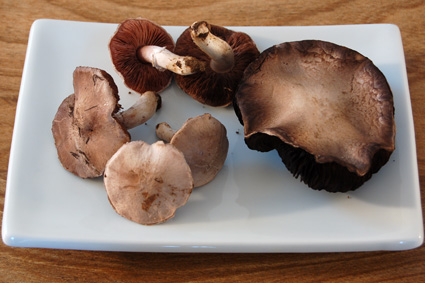
Agaricus mushrooms

So here they are. Most of them, anyhow; it was an overflowing handful. I'm fairly sure that there were a few more coming up where I found them, as well. As soon as I got them home, I started searching through the various identification books2 I've got. The verdict? Unsure. I've narrowed it down to (most likely) the Agaricus genus, but can't find a clear match. The good old field mushroom, Agaricus campestris, is the closest thing, but just not close enough.

Ring on the stalk, with a delicate texture, missing on some? Yup.

Lack of a cup-like volva at the base of the stalk? Yup.

Gills free from the stalk? Yup.

Stalk separates easily from the cap? Yup.

Gills pink when young, becoming dark chocolate in maturity? Yup.

Spores chocolate brown to blackish? Yup. (Chocolate brown, I'd say.)

Staining yellow? Nope. Not staining any color.

Cap color? Ranging from pale tan to chocolate brown around the edge, especially on the largest and oldest one.

It even smells just like a crimini or white button mushroom. Even a brief taste3 suggests that.

The primary reason it doesn't seem like Agaricus campestris? The edges of the caps are irregularly turned up on the older mushrooms. I've seen pictures and descriptions of other mushrooms that do that, but rarely for the Agaricus species. I'd think that would be a distinctive enough feature to be worth noting - and of the three books handy, not a single one mentions it. But, hey, I'm getting some good use out of these books, all of which are careful to note that there are untold species out there, either unidentified or not well enough known to make it into any (let alone every) guide.
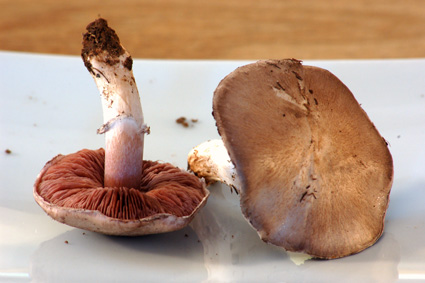
Agaricus mushrooms closeup

They're also alerting me to the many, many bizarre characteristics of the fungi out there. As just one example, take the range of mushroom toxins. Utterly fascinating.

A few include:
  • Amatoxins

    About a half dozen of these chemicals appear in the group called the deadly amanitas, as well as some Lepiota and Galerina fungi. They even occur, in extremely tiny amounts, in chanterelles and porcini, which are pretty much tops in terms of edibility.

    One book notes amatoxin poisoning as being "of the worst type". Six to twenty-fours hours pass before abrupt, violent vomiting and diarrhea begins. This coincides with serious damage to the liver, kidneys, heart, and central nervous system. No wonder that species such as Amanita virosa and A. phalloides have picked up names like destroying angel and death cup.

  • Gyromitrins

    These potentially fatal compounds are usually found in the false morels. Some old guides considered these mushrooms edible - following parboiling and discarding the water or drying, both of which destroy nearly 99 percent of the toxin - but that doesn't seem to be the case anymore. Even the small amount that remains has proven highly carcinogenic in small mammals, and there's always the possibility of not doing it well enough.

    Especially since the toxins have a similar delayed onset, followed by up to two days of vomiting and diarrhea, then potential liver and/or heart failure. So, even if it doesn't kill you, you might wish that it did.

    It's interesting to note that one of the false morels that contains gyromitrins is Gyromitra esculenta. The esculenta portion of that means "edible", which it most certainly isn't. Not on my list, anyhow.

  • Orellanine (Cortinarin A and B)

    This, I think, has to be the most insidious mushroom poison. It show up in some Cortinarius species, and isn't too different, chemically, from the amatoxins. The symptoms include an intense, burning thirst, gastrointestinal disruption, headaches, aches and pains, spasms, and loss of consciousness. Then rolls in the kidney (and sometimes liver) damage. But why's it so insidious?

    The onset of the symptoms usually comes three to fourteen days after eating the mushrooms. Up to two weeks? Even if there were something to do about it - the book notes that "[n]o specific therapy is known" - how the hell would you figure out what was causing the problem?

  • Muscarine

    Even though this one's characteristic in the fly amanita - the red toadstool white white spots from a million illustrations - it's not the primary toxin there. It does show up in a variety of other species, including Clitocybe dealbata, the so-called "sweating mushroom".

    So-called because the symptoms of muscarine poisoning include greatly increased secretions of sweat, saliva and tears, in addition to the usual diarrhea and vomiting. It can be deadly in severe cases.

  • Ibotenic acid and Muscimol

    Here're the main toxins in Amanita muscaria. Sometimes it results in serious vomiting, though it's best known for the hallucinogenic (and related) effects: confusion, muscle spasms, delirium, and hallucinations. In certain areas - specifically parts of Siberia - these mushrooms were (or are) used for their intoxicant effects.

    Here, though, the toxins skew a little more to the vomit-all-day-and-wish-you-were-dead side. Apparently, at least in central Pennsylvania, there are virtually none of the hallucinogenic side effects - one book notes that some here have tried, but the author couldn't find anyone who'd even entertain the notion of trying again.

  • Psilocybin-Psilocin

    These would be the chemicals causing "particularly vivid and dramatic" hallucinations. I'm also informed that simply picking mushrooms containing these toxins can be a federal crime - i.e., possession of illegal substances of some sort - so it pays to be careful about what goes into the harvesting basket.

  • Coprine

    If I could have a favorite mushroom toxin, this would be it. Hands down.

    As near as I can tell, this only occurs in the alcohol inky cap, Coprinus atramentarius, an edible mushroom that's generally considered quite tasty. See, it's not toxic on its own; it's only when consumed with alcohol that it becomes a problem. One source suggests abstaining from alcohol twenty-four hours prior to and up to five days after eating, just to be safe.

    Symptoms don't take long to appear; about thirty minutes is all. First, the person feels hot and the skin flushes red, and breathing becomes rapid and difficult. Then come the usual suspects of violent headache, nausea, vomiting, and more or less feeling like hell for a few hours. Some people are more or less sensitive, but it's worse with more mushrooms, more alcohol, and a shorter period between consumption of the two.

    It seems that a certain cycolopropyl amino-acid derivative in the mushroom gets turned into cyclopropanone in the body, which then interferes with the liver's ability to metabolize ethyl alcohol. A synthetic drug, disulfiram, does pretty much the same thing when given to alcoholics to them curb their drinking. Neat!
And there's so much else that's just genuinely amazing about these fungi, which I'll get around to as I actually see some of it in person.4 Potential options: mushrooms that taste like chicken; mushrooms that bleed blue milk; mushrooms that glow in the dark; mushrooms that look like undersea coral; mushrooms that smell like maraschino cherries, or anise, or rose and apricots.

Of course, I'd be thrilled if I could just find a few good morels or chanterelles next year.

* * * * *

1For starters, I'm anxious to go morel hunting come spring. Assuming that I can actually spot them, they're dead easy to identify. Then there's the fact that chanterelles and black trumpets grow in this area - two mushrooms of significant culinary renown. Top that off with the recent "Steve, Don't Eat It!" on the sulfur shelf, and I'm anxious. Oh, and finding edible Coprinus micaceus and Coprinus comatus mushrooms while out walking in Madison didn't hurt.

2The Mushroom Hunter's Field Guide by Alexander H. Smith and Nancy Smith Weber; The New Savory Wild Mushroom by Margaret McKenny and Daniel E. Stuntz; and Field Guide to Wild Mushrooms of Pennsylvania and the Mid-Atlantic by Bill Russell. Thanks, library card!

3At least one of the guides notes that it's impossible to poison oneself by simply touching a mushroom to the tongue for a taste. It uses the specific example of the destroying angel, Amanita virosa, perhaps the deadliest mushroom in the world. Half a cap of that mushroom will most likely kill an adult.

4I'm planning on leaving the whole poisoning aspect in the realm of abstract understanding.

08 October 2007

Yeast.

Lewisburg.

The house smells like yeast.

This is okay. It's a yeast-intensive time around here. A loaf of sourdough has just gone into the oven; my first-ever batch of cider is fermenting, the airlock bubbling away furiously. Unlike the more usual loaves of bread and bagels made in this kitchen, there's an air of uncertainty about these. Except in the unusual case where the yeast has been around too long1 and no longer leavens, a regular loaf of bread is very predictable. Temperature and humidity keep it from running like a Swiss watch, but even so, you can schedule it into your day. Sourdough and alcoholic fermentation, however, fit you into their schedule.

Sourdough can be frustrating. Feedings2 aside, the process of making a loaf involves multiple additions of flour and long, separate risings. It also takes more effort to knead; the dough likes to remain sticky, and can form long, highly elastic gluten strings that make it look like the kneading'll never be finished. Even the timing's difficult, as the timing of the latest feeding (among other things) may mean the initial rise should be anywhere from twelve to eighteen hours. But it does make a wonderful loaf of bread.

Alcoholic fermentation - in this case, apple cider - is another crapshoot when it comes to timing. From what I've gathered, the primary fermentation should take roughly seven to ten days; time in the secondary should be at least another two weeks, plus two to four more for bottle conditioning and carbonation. On the upside, cider - unlike beer - doesn't require boiling five gallons of sugary liquid, meaning there's less to clean.

While there are distinct differences in how these two yeast-driven processes work - sourdough is leavened by yeasts of the genus Candida and soured by Lactobacillus bacteria, while alcoholic beverages are fermented by different species in the Saccharomyces genus3; for bread, the aerobic processes of the yeast produce carbon dioxide, letting the bread rise, and for cider, the anaerobic processes generate alcohol - it's worth noting that working with either requires you to observe it all indirectly. Yeast cells are really difficult to see, even when squinting, so you have to watch the results of their action and hope for the best.

Signs to look for: the expansion of a loaf of bread dough, seeing that it's risen enough (and thus won't be too dense) but not too much (and so won't rise in the oven, but might fall instead), all while making sure that the acids and enzymes produced by the yeasts don't break down the gluten network and reduce the loaf to a sticky sourdough batter; the vigorous bubbling from a fermentor's airlock (though if it gets too vigorous, the airlock may get ejected by the force of the carbon dioxide produced); or even the smell. The kitchen smells of a combination of yeasty action - the aroma of rising bread - with the changing cider, moving from the sweet richness of freshly pressed apples to a more delicate scent, lighter, like a distillation of the qualities of the apple. It sure seems like it's going well... but it'll be weeks before I know with any certainty.

It's the risk - and the rewards, of homemade goods not quite like anything available in a store - that makes it all interesting. Will it all turn out well in the end? Probably. But I've failed before. And been pleasantly surprised, too.

* * * * *

1It's never happened to me, but I suppose it's bound to eventually.

2I've changed my regular feedings slightly to cut down on the salt. Though it didn't kill off the starter culture, the salt definitely slowed it down - to the point where the yeastly/bacterial enzymatic action breaking down the gluten threatened to outpace the bread's rising. I still add some, in every second or third feeding, and it's definitely improved.

3In this case, I'm using a strain of Saccharomyces bayanus from Champagne, hoping to keep a neutral - and still apple-y - flavor profile.

11 September 2007

Gelatin clarification.

Lewisburg.

Molecular gastronomy: cooking for the gadget- and science-obsessed. Cool, complicated, and making use of anything and everything in the race to be different. So, for the most part, not the sort of cooking any of us do at home.

Exception: gelatin clarification, as explained by Harold McGee in last week's New York Times. It's slow - which is why I'm writing about it nearly a week after the article - but remarkably effective. For example:

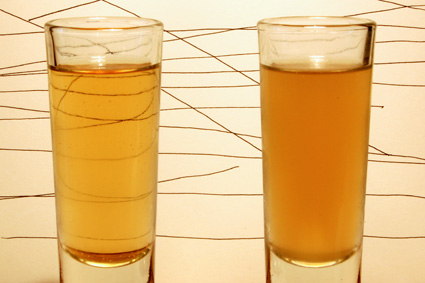
Gelatin clarification

On the right, unclarified duck stock. On the left, the same stock after the clarification. Pale, clear, and with a more intense flavor. It's a trade-off for the lack of body, of gelatin, which served as the filter.

So, yes, it works. Well, and without much effort - though I do find that the process works better in a slightly warmer environment than my refrigerator, which I keep cool enough that the stock was quite slow to melt. Things moved along much better once I took to transferring the straining consommé to an insulated cooler with an ice pack, replacing it every so often (and keeping it all in the refrigerator when I wasn't around to keep tabs on it).

Next step: creating consommés out of unusual ingredients. In addition to their uses in cooking - broths, poaching liquids, etc. - they'd be perfect for infusing flavors into new places. Sorbets with flavors beyond fruit juice and infused herbs. Brilliantly clear cocktails - the Bloody Mary, the Bellini - with traditional or new flavor combinations; it's like creating the nonalcoholic equivalent of homemade bitters or vermouth. Breads - from crusty loaves to tender crepes - that don't have to sacrifice texture to get aromas of fruits, nuts, or cheeses. In essence, any place that water would go, there's now an opportunity to add another layer of flavor.

If only I had another refrigerator and freezer.

08 August 2007

The Bitch is back.

Lewisburg.

In this case, I'm referring to the latest sourdough starter,1 not the Elton John song. Though that episode of This American Life where Starlee Kine and Jon Langford assemble a band from the classified ads to play "Rocketman" is pretty sweet. But I digress.

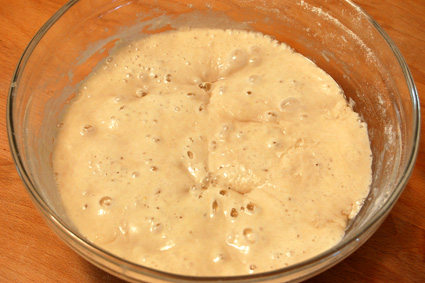
This is my second attempt at a sourdough starter, a few years after the last one succumbed to what I suspect was a bacterial infection. Regular time at home - necessary for the frequent feedings and baking a starter requires - had been in short supply from then until now. So far, so good, as you can see:

Sourdough starter

The summer heat, it seems, is moving the process along briskly. This may present some problems, especially over the long term, but I'll just have to wait and see. A sourdough starter is essentially a living colony of wild yeasts and bacteria - usually lactic acid bacteria, hence the "sour" quality - that offers a handful of pros and cons in bread baking. Some sourdough facts gleaned from Harold McGee's On Food And Cooking:
  • The bacteria help delay staling, and the acids help prevent spoilage.

  • The more acidic conditions of the dough reduce Maillard browning reactions, resulting in a lighter-colored loaf.

  • Sourdoughs don't rise well; the bacterial populations outnumber the yeasts by several orders of magnitude, inhibiting gas production. In addition, the acids and protein-digesting enzymes weaken the dough's gluten network.

  • Starters require frequent feedings, since microbes consume nutrients rapidly, and refreshing the starter dilutes the buildup of acids and other growth-inhibiting substances. Twice a day is the standard, though some starters may require more than that. Liquid starters, in which the microbes have easier access to nutrients, require more frequent attention than more solid starters.

  • Starters work best for breadmaking when they're at their most active, bubbling away.

  • Temperature control is important. Yeasts thrive best at 68-78°F; bacteria at 86-96°F. Thus, starters and rising doughs work best when kept relatively cool.

  • Salt's a good thing. It limits the effects of the protein-digesting enzymes from the starter's bacteria, and helps tighten the gluten network.
With that in mind - though limited by the fact that I have no control over temperatures in the house2 - I've modified the (previously successful) recipe for a wild yeast starter from Joy. The only real modification I've made is to include salt, guessing that the same proportion I use for bread ought to work well; a teaspoon salt per cup flour doesn't seem to inhibit yeast growth. Joy also mentions that some starters are made with fresh or dried hops - originally used in beer brewing to retard bacterial spoilage - but, as I don't have any handy right now, they'll have to be part of a future batch.
Wild Yeast Sourdough Starter

Ingredients
  • Bread flour
  • Salt
  • Water
Directions
  1. In a very clean, small mixing bowl, mix together ½ cup bread flour, ¼ cup room-temperature water, and ½ teaspoon salt. Stir together until you start to see signs of gluten formation - the development of stringiness and elasticity. Cover tightly with plastic wrap, and use the tip of a sharp knife to poke half a dozen holes in the plastic. Let stand at room temperature, away from drafts, for 12 hours.

  2. Mix another ½ cup bread flour, ¼ cup room-temperature water, and ½ teaspoon salt into the starter. Re-cover the bowl and let stand another 12 hours.

  3. Transfer the starter to a clean bowl, and stir in another feeding (½ cup bread flour, ¼ cup room-temperature water, and ½ teaspoon salt). Re-cover and let stand another twelve hours. If, by this point, the starter has not risen and started bubbling, discard and start over.

  4. Stir in another feeding, and cover the bowl with new plastic, without holes. Continue feeding, every 12 hours, for another day. The starter should have a slight sour aroma, and is best used when at its bubbliest, about halfway between feedings. If twice-daily feedings result in more starter than you can use, refrigerate and feed weekly.
I'll try to post more as the sourdough-making process continues. Provided, of course, that I remember to feed The Bitch, or she'll die.

* * * * *

1As I'd noted before, the name comes from Anthony Bourdain's Kitchen Confidential, and will, before long, result in a kitchen sign reading, "Feed The Bitch or she'll die!"

2No air conditioning. And the rather small basement keeps nice and toasty due to the oil furnace that provides us with hot water and, come wintertime, heat throughout the house. So, unless I come across an inexpensive secondhand refrigerator that I can override with a controllable thermostat, the starter'll just have to deal with ambient air temperatures. Unfortunately, the same limitations apply to homebrewing, which is decidedly less forgiving than bread baking - and which is all the more reason to keep my eyes open for a spare fridge.

29 August 2006

Buck Rogers bicycles.

Chicago.

In an interesting1 new development in food science, scientists have developed a way to use bacteriophage viruses to keep lunch meat fresh. More specifically, they're using phages to destroy Listeria monocytogenes, which is not the sort of thing you want in your food. The upside is that there will be less potential for food poisoning from Listeria; the downside is that there could be some unintended consequences, like breeding resistant strains of the bacterium. The researchers claim that using a "cocktail" of several strains of phages will kill off all of the bacteria - meaning there'll be none left to evolve into anything more dangerous. How true that may be, no one knows.

Of course, this also means there could be a new ingredient to add to the end of the list for sliced meat products: "bacteriophage preparation". Well, it doesn't sound as terrifying as some of the other things2 that show up in processed foods. I mean, it's not as though everyone isn't covered in billions3 of phages right now, all doing whatever it is that viruses do to pass the time. If you're happily noshing at Subway on a regular basis, none of this can be any scarier than what's already a normal meal.

Speaking of eyebrow-raising human ingenuity, an LA Times article on human-powered vehicle (HPV) racing is well worth the read. It's a geek sport, a combination of engineering know-how, cycling skill, and no shortage of beyond-all-good-sense dedication. What about that combination isn't fascinating?

If that doesn't sound thrilling enough, consider these tidbits: the sport consists of bicycles that race at fifty-five miles per hour and above; the aerodynamic enclosures look like something out of Buck Rogers; and sometimes, in that desperate lunge for better speed, riders pedal vehicles without windshields, using cameras and video screens. These "camera bikes" have a strong tendency to crash and run objects over, since it's maddeningly difficult to steer a bicycle using a TV. Then again, the European speed record holder4 rides backwards and watches the course through a mirror.

And cable television hasn't turned this into a reality show yet?

* * * * *

1Meaning that I don't know if this is a good thing or a bad thing.

2Sodium stearol lactylate, anyone? How about some partially de-fatted cooked beef fatty tissue? Or, perhaps, a little mechanically separated meat? Okay, I'm done being gross now.

3Or maybe trillions. I have no idea. I'm just sure that the number involves many, many zeroes.

4Damjam Zabovnik, from Slovenia. 73 mph.

23 August 2006

Mathematical tools.

Madison.

I've been thinking about mathematics a fair bit1 lately. This is due, for the most part, to the fact that the New York Times noted the Fields Medal awards today. This is, in case you weren't up on your high-level scientific honors, the mathematical equivalent of a Nobel Prize. Though a number of prominent mathematicians have been awarded Nobel Prizes, it's always been for the application of their research to other fields, like Economics or Physics. The Nobel - with the exception of Literature - seems like awards for practical results, after a lifetime of work; the Fields Medal2 only goes to young researchers (under 40), and doesn't need to apply to anything particularly useful.

Useful to you and me, the average person, that is. Fields Medalist-level research is big, big stuff in the world of mathematics. Potentially physics, chemistry and other related fields, too.

The big deal this time around - Fields Medals only come once every four years - is that Grigory Perelman has officially solved the Poincaré conjecture. (Actually, he did it about three years ago, but the verification of his work has taken quite some time.) Without getting into the details3 of it, he's managed to solve a central, nagging problem in topology. Henri Poincaré posited it in 1904; a century later - using a novel combination of mathematical tools unavailable to Poincaré - a proof exists.

What caught my eye in all this was that the Poincaré conjecture is4 one of the Millennium Prize Problems, a group of seven unsolved classical mathematical problems. The Clay Mathematics Institute, at the turn of the millennium, set out seven one-million dollar prizes for published, peer-reviewed solutions to these problems. One example is the Navier-Stokes equations, which is used to describe fluid flow. I studied them in college. The equations have been around since the 1800s, and have been useful in all sorts of applications. The difficulty lies in the fact that no one really understands them, or can really use them without making a lot of assumptions5 along the way.

So, math is much more intense than most of us give it credit for. This probably applies to most fields of study, I suppose, but math gets a pretty bad rap all around. I think that much of this is due to the fact that the average brush with mathematics is boiled down to simple process. From grade school arithmetic through multivariable calculus and differential equations, nearly every math course6 I took in my years of school was based on solving problems, in search of an answer. Usually something numerical.

At the dentist's office7 yesterday, the hygienist commented that she really liked math. It was straightforward, she said, and you could always work backwards to check your answer. Even if I didn't have a mouthful of dental implements, I wouldn't have the heart to correct her. I used to think about it that way, which, when you're studying engineering, is a sufficient sort of understanding. Not exaclty enlightened, but practical enough. Since then, though, I've started to realize the complexity of the whole field.

I'm beginning to think of mathematics as a tool. A powerful one, like a good hammer. Everyone has some conception of a hammer; nearly everybody's used one at some point. It's something you'd expect to find in any toolbox.

For those who don't use one regularly, a hammer's a basic brunt-force type of object. You tap a nail in lightly, then try to whack it in with all your might, ideally avoiding any sort of thumb-crushing. Don't pay attention to how you're using it, and you'll end up with a sore arm and wrist. Every so often, a glancing blow bends the nail over, and you've got to start again. This is math for most of us. We'll use it when we have to, but we're no good at it, and it's probably a crappy hammer, anyway.

Really, though, a hammer takes some skill. Some practice. As simple a tool as it may be, it demands your respect. A skilled carpenter can sink nails much faster, much easier and with greater accuracy than most could with a pneumatic nail gun. The tool, more like an extension of the arm, can do a phenomenal amount of work with very little effort. Sure, building a house with hand tools takes a long time, but so does solving the Poincaré conjecture. Not many of us could really do either in our lives.

* * * * *

1Despite the fact that I'm married to a mathematician, and that a good number of my friends are mathematicians, I don't spend much of my day thinking about it. In fact, I tend to glaze over when the subject comes up.

2You could also think of it like the MacArthur Genius Grants. We like what you're doing; here's a pile of cash, no strings attached.

3Since I'm a bit fuzzy on the problem, in general. The details are far beyond me. "Coffee cups = donuts" is about as far into topology as I get.

4Was?

5The first case, if I recall correctly, was to assume that the fluid wasn't moving, in order to predict pressure changes at varying depths of a fluid. When nothing's moving, all sorts of terms become zero and drop out, which makes calculations much easier.

69th grade geometry had some very basic proof work in it, but even that was directed at a single right answer.

7Always remember to brush and floss regularly. Your dental hygienist will thank you.

15 August 2006

Still impressed by digital watches?

Chicago.

This is so depressing. (If you prefer, go ahead and get depressed by the accompanying graphic.)

I see two1 potential explanations for Americans' failure to grasp evolutionary theory:

1. Americans are scientifically illiterate. A few reasons to suppose this:
  • Religious fundamentalism, in various splintery forms, has come back with alarming strength, attempting to replace science and rationality with various twists on "because I said so."2

  • There's a strange aversion to understanding the sciences in this country, even among the well-educated. One can be well-versed in the arts and, somehow, wear scientific illiteracy as a badge of honor. Overall, there's a distinct current of anti-intellectualism these days, and the sciences seem to have it the worst.3

  • Science - in light of the previous two points - has become a political issue. Not that this is the first time, of course. (See Galileo Galilei for a well-known example.)
2. Americans haven't actually evolved from the various apes, monkeys, and other animals down the evolutionary tree. Reasons to suppose this:
  • Religious fundamentalism and an irrational fear of science seem like the sort of abstract concepts a chimpanzee could handle. Perhaps also some of the more cunning monkeys.

  • With the recent advances in electrolysis, shaving technology4, cosmetic surgery and related fields, your average gorilla or orangutan stands a fair chance of passing for human.5

  • Have you looked around the internet? Monkeys on typewriters. In case you're short on handy examples, you might want to try the Weird Earl's archive on the Straight Dope website.

  • I wouldn't be at all surprised to find out that the loudmouth, right-wing blowhards on radio and TV are actually well-groomed6 baboons. Loud, angry, prone to resorting to threats and violence to resolving conflicts? Sounds like baboons to me.
* * * * *

1Okay, three. The paper's authors could be making this up, just for kicks. If only that had the tiniest potential of really being true.

2This sort of logic is okay when arguing with four-year-olds. There's a reason - actually, lots of them - why evolution is the current scientific theory. For starters, there's the fact that it stands up to the scientific method approach of testing hypotheses and such.

3I'm counting mathematics in among the sciences. If I couldn't handle basic arithmetic - say, doubling a recipe or calculating a tip - I wouldn't consider it a funny, slightly self-deprecating thing to mention at parties. I'd put it up there with being unable to read. It's rare to find someone who's proud of being illiterate these days. Especially someone who doesn't appear to have a host of mental problems, as well.

4I use a shaving brush and soap, and I'd consider using a straight razor if I knew where to get one.

5Lrrr: "I recognize her slumping posture and hairy knuckles."

6Heck, the ones on the radio don't even need to wash up.

01 August 2006

Some small thoughts.

Chicago.

A smattering of little thoughts are running about my head today, and in order to avoid going outside for as long as possible, I'll address each one in turn.1

Really?
I love reading the weekly Really? column in the New York Times' Science section; it's like a straightforward2 version of the Straight Dope. Each week, it refutes or reassures some claim of general common sense. This week, it's about keeping minor wounds moist, instead of dry. In particular, I was interested to note the bit about not applying antibiotic ointments. I presume that this means repeatedly. Though I make it a point to wash well whenever I cut myself, I've always considered an initial application of a topical antibiotic worthwhile. And it's good to know that my absent-minded habit of picking away old scabs isn't doing me any long-term damage.

Don't eat the Uni.
Frank Bruni, restaurant critic for the New York Times, generally raises some interesting points in his blog, but his new series of interviews with chefs looks especially enlightening. The first is with Rebecca Charles of Pearl Oyster Bar. She's down-to-earth, always a respectable trait, and I appreciate a number of her answers.
  • What significant meals does she remember? Rustic, English country food3 and a simple roast chicken with frites in Belgium. Having had the wondrous delight that is the real Belgian frite, I can understand.

  • What's most underrated in the kitchen? Salt and pepper. Sometimes - especially in the summer, with all of the great produce available - everything just tastes best without any additional embellishments.

  • What food can't she stand? Sea urchin. I have to concur. I tried it once - uni, sea urchin roe sushi - and hated it. It tasted like salty milk.4
Six rules.
Yesterday, I successfully talked a coworker out of buying out-of-season strawberries, on the premise that they wouldn't taste very good. Of course, since she's may never have had good, fresh, ripe, local ones, she can only take my word for it. So, to back it up, I referred her to The Omnivore's Dilemma. I can probably make some points in addition to those that Pollan raises, but not much.

After that, I recalled that Pollan had written a short piece for Time magazine, entitled "Six Rules For Eating Wisely." It's a common sense - and amusing - approach to feeding yourself well. Or at least a little better. His rules:
  • "Don't eat anything your great-great-great grandmother wouldn't recognize as food." Generally, this means avoiding pre-packaged, processed stuff. Though we Americans don't have an established food culture - we have a whirling array of fad diets and "magic bullet" approaches - thinking like long-ago ancestors might help nudge us in a saner direction.

  • "Avoid foods containing high-fructose corn syrup (HFCS)." There was a recent article in either the New York or Los Angeles Times that addressed the controversy over HFCS in foods. The problem with it, I think, was that it targeted that single ingredient, rather than treating it as an indicator. As Pollan points out, HFCS only shows up in highly-processed foods, the sort that are more "food product" than "food." Eliminating HFCS also helps reduce the sorts of things that come loaded with other questionable ingredients: lots of sodium, fat, extra sugar, etc.

  • "Spend more, eat less." I try to take this approach, especially with the sorts of foods that should be special. Good meats come to mind as an example. Beer and wine, too; I'm comfortable paying extra to savor and enjoy something, rather than simply bolt it down like a commodity. When I've paid more for something, I'm more willing to take the time and effort to enjoy it.

  • "Pay no heed to nutritional science or the health claims on packages." In our advertising-saturated culture, the "magic bullet" gets a lot of play. The only reason nutritional claims show up on cereal boxes is to help sell more of them. They're about as fair and balanced as Fox News.

  • "Shop at the farmers' market." Oh, for so many reasons. They could fill a book.

  • "How you eat is as important as what you eat." If eating is simply a sustaining activity, it becomes mindless. When it's a social endeavor, a ritualized event with meaning, it becomes something special. Something worth thinking upon.
It's worth noting that these points, though distinct, really do have a lot of overlap. They're simple, but have the potential to be very effective.

Kathy's shirt.
This I should I have mentioned with the market stuff yesterday, but I forgot. Kathy finally got a shirt from John and Dorothy. See their newsletter for the story behind it. I can't recall exactly, now, but I think it's green, with yellow, lower-case lettering, and spells out "if i ate meat, this is the meat i'd eat". When your favorite beef and pork farmers have a vegetarian stumping for them, you know they're doing things right.

* * * * *

1I'm dawdling inside for several reasons: the weather outside is extremely hot and humid; the air conditioning is actually working in our building this week, which is a pleasant surprise; my apartment here has no air conditioning or cross-ventilation; and there's a Cubs game tonight, so I couldn't get on the northbound Red Line if I wanted to.

2As in less snarky, and generally not particularly humorous, but always containing a nugget or two worth remembering.

3The English can actually cook. Granted, not everything is great - and some of it is outright bad - but in capable hands, you can get some very excellent comfort food. Most of it also pairs very well with beer, and the British have an strong tradition of diverse and well-made ales. (The continued presence of which is attributable, in no small part, to CAMRA, the CAMpaign for Real Ale. In both the UK and the States.)

4I should point out that I don't drink milk. Though I love most dairy products, the taste of plain milk turns my stomach.

23 March 2006

Blue garlic?

Madison.

In preparation for having a bunch of folks over for food tomorrow night, I started making some pickles. They've been a consistent hit around here, particularly the garlicky dill cucumbers, so I figured I'd try something like that again this time, only with the sort of vegetables that look good this time of year: onions, carrots and fennel. A quick taste test tells me they're a might heavy-handed on the fennel, since everything's taken on a distinctly anise-like quality, but it's not too bad. Good to make a mental note for next time, though.

What's weird, and why I bring this up, is that the garlic cloves have turned blue. I think this may have happened before, but I'm not sure. And, since I don't usually think of bright blue as a naturally-occuring food color, I felt obligated to check up on this. According to Harold McGee's oh-so-handy On Food And Cooking:
Red-Purple Anthocyanins and Pale Anthoxanins
The usually reddish anthocyanins and their pale yellow cousins, the anthoxanins, are chlorophyll's opposites. They're naturally water-soluble, so they always bleed into the cooking water. They too are sensitive to pH and to the presence of metal ions, but acidity is good for them, metals bad. And where chlorophyll just gets duller or brighter according to these conditions, the anthocyanins change color completely! This is why we occasionally see red cabbage turn blue when braised, blueberries turn green in pancakes and muffins, and garlic turn green or blue when pickled.
He goes on to explain a few other interesting tricks with color-changing anthocyanins:
  • Adding alkaline substances to red wine will turn it into white wine.1
  • Quinces and other pale-colored, very tannic fruits can be cooked to produce anthocyanins. As the aggregate phenolic chemicals break down, they become anthocyanins, rendering the fruit both gentler on the tongue and bright red.
  • Trace amounts of metals in the cooking liquid can turn different anthocyanins all sorts of different colors.
These same chemicals are the ones that turn some kinds of asparagus, snap beans and carrots purple. Since they're only present on the outside, they usually end up diluted in cooking water or interact with the other plant cell chemicals, losing their color.

* * * * *

1McGee points to Marcus Gavius Apicius, the author of the only known surviving Roman cookbook. Apicius suggested:
To make white wine out of red wine. Put bean-meal or three egg whites into the flask and stir for a very long time. The next day the wine will be white. The ashes of white grape vines have the same effect.
Neat party trick, especially for someone you really loathe. I can't imagine it tasting anything other than awful.

19 March 2006

Very slow food.

Madison.

Been thinking a lot on slow cooking lately. As in, the sort of cooking that takes hours upon hours, if not days, to do. The key difficulties with this, currently, are:
  • A lack of fancy, high-priced equipment. Those big smoker-grills, with the sidecar fireboxes? A few hundred bucks, and even the smallest ones weigh 200 lbs. and up. Not the sort of thing I've really got storage space for. Even pricier are the chemistry-lab-type water baths for sous vide cooking, at roughly fifteen-hundred a pop. (Plus the hundred-dollar vacuum-sealer to go along with.) Since the oven won't hang out below 200°F, and a stovetop water bath can't manage a bare 135°F, I'll need to be more creative.
  • Storage space. It's not something I've got just lying around, so to speak. The charcoal grill already takes up most of the space in the coat closet. Homebrewing, canning and gardening equipment (plus the bicycles) have taken up all of the available space in the basement. Any new equipment has to be small.
  • Time, of course. In addition to having a job that actually requires me to show up and do stuff, five days a week, some of that has to happen in Chicago. Really throws a monkey wrench into some things, and makes planning a lot more critical.

Still, that's not going to stop me. Not if I can do anything about it. I think the solution, or at least the key part of it, is an electric hotplate. Being a little more low-powered than the stovetop burners, it ought to be able to maintain a very low-temperature simmer. I think. At any rate, since they rarely cost more than twenty dollars, I won't feel too bad if it's not what I'm expecting.

The real benefit of the hotplate, though, is that I ought to be able to use it for outdoor smoking, a la Alton Brown. I could probably use the charcoal grill, combined with a Saturday's worth of vigilant coal-watching, but I haven't yet mastered charcoal. And with the charcoal grill limitations here in Madison - gotta keep it 10 feet from the building, which means it's off the patio and onto the grass - keeping a constant supply of hot coals can be a pain. A hotplate, though, should provide the reliable, constant heat to smolder hardwood sawdust for as long as necessary.

Of course, even a hotplate may produce too much heat for effective cold-smoking. Maybe even hot-smoking, though that'll need to be tested. I'm thinking I need to build a series of smoking chambers to create a more effective system, as in:
  • The smoke-producing chamber. Probably a cardboard box, with the hotplate, a pie pan full of sawdust, and a fan-powered exit tube. Plus a small door for replacing sawdust from time to time. This should, at least, eliminate any problems with radiant heat. The key difficulty here is finding an appropriate fan; my initial guess is that a computer fan ought to be the right size for the job.
    One side benefit: since the heat source is electric, I can build this setup on the concrete patio. No concerns about fire too close to the apartment building.
  • The cooling chamber. I'm still a bit fuzzy on this one, since I don't know what sort of temperatures I'm dealing with. The simplest version is to make the smoke tubing long enough that it'll cool the smoke through extended contact with the air, like a really low-tech heat exchanger. I could beef it up by running it through another chamber (read: cardboard box) with a tray loaded with ice at the bottom, to get a little more cooling power. Or, to take it a step further, run the whole shebang through a cooler filled with cold water. That sounds like it's reaching into difficult territory, though, requiring more money and storage space that I haven't got.
  • The food-smoking chamber. Another box, with a pair of wooden dowels to support a cooling rack right in the middle. The tubing enters from one side to fill it with smoke, presumably at the temperature I'm looking for. A tray of ice, if necessary, to cool things down a little more. Just leave the food in here for as long as necessary, and then it's off to the next step in the process.

That seems to make the most sense to me, though I've yet to work out all of the details. Like, how do I get power out there? I'm hoping to be able to rig up a medium-base socket to a three-prong outlet so I can plug into the porch's light fixture, rather than running an extension cord out the door. (If that's what I need to do, then I'll have to rig up a bug screen to seal up the door.) And how do I determine the best way to build the cooling chamber(s)? Without too many iterations, at least. I'm sure there's more I haven't thought of, as well.

In the end, I'm confident that the results of this'll be entirely worth the effort.

24 February 2006

I ♥ Progress.

Madison.

I had the good fortune to catch a lecture by Harold McGee, the author of On Food and Cooking: The Science and Lore of The Kitchen, last night. Essentially a history of science in cooking, and hitting just a few of the highlights, he made a point that we can all perform science experiments in the kitchen, at home, and improve our understanding of the ways we cook and eat. As an example, one he undertook with a bunch of willing friends: will a silver spoon in the neck of a bottle of Champagne keep it good until the next day? There may be better excuses for a party, but not many.

The experiment goes like this:

1. Decide on how many different variations you want to try. Silver spoon? Why not stainless steel, or plastic, or even wood? What about just leaving the neck open? Or re-sealing it with a cork, or a wine vacuum-sealer? Or pouring it into some other container you've got handy? One variation, at least, ought to be at least one freshly-opened bottle to act as a control against all of the other test cases.

2. Pick up a case or more of sparkling wine, as needed for all of those variations and the size of the party crowd. If you can afford real Champagne, then, hey, go for it. McGee's experiment used California sparkling wine, and that's probably what I'd use. Whatever you choose, make sure all of your bottles are of the same wine.

3. The night before the party, open up all of the test bottles. Pour out, say, half of each. (Don't waste it, though. This is another fine excuse for a party.) Add spoons, corks, whatever, and let 'em sit until the next night.

4. Do a blind tasting at the party, so no one's biased by any preconceived ideas. Ask everyone to rate each wine on a couple of key characteristics. Use whatever you like. Bubbliness is probably crucial (since that's mostly what the experiment's about), but it's probably worth including aroma, taste, aftertaste, appearance, and other sort of basic stuff. Rating things on a number scale (1-3 or 1-10) may be simplest to tally up at the end, but it's probably worth including a spot for any notes or comments. If some appear to have lost (or gained) certain tastes and aromas, that's well worth noting.

5. Tally it all up and see what trends you find. In McGee's experiment, they actually found that the silver spoon bottle and the open neck bottle were rated highest, even higher than the freshly-opened bottle. That suggests that there's something a little unpleasant in that wine that dissipates when it's allowed to sit a while. Not what you might expect, but a great little discovery.

Another food-related party experiment I like (conceived by my friend Michelle's aunts Beth & Margie): when it's asparagus season, have a dinner party and serve plenty of it. Keep everyone around for a good, long time and serves plenty to drink, so people will need to head to the bathroom at some point. Keep a checklist in the bathroom for people to note if their urine smells like asparagus or not. Classy.

The options are, more or less, endless, limited only by your imagination, budget, and the willingness of your friends to try something a little unusual for the sake of science.

Another good source for mixing cooking and science: Alton Brown of Good Eats. Technologically savvy, good at jury-rigging, and keen on pop culture. His books, I'm Just Here For The Food and I'm Just Here For More Food are some of the handiest cookbooks available.