Showing posts with label Movies. Show all posts

02 November 2009

Disturbing. Depressing. And The Big Lebowski.

Lewisburg.

I've come to an interesting realization of late: I tend to use pop culture as sort of mood reinforcement. I find this odd, for a simple reason. If I'm feeling low, wouldn't it be best to watch something like The Big Lebowski?

So Sharon's been out of town for most of the last two months, the sole break being about six days back to visit and go to a conference.1 As one might imagine, this is not conducive to good times. I do, however, make all decisions regarding pop culture consumption solely to suit my own interests. My selection of Netflix films for September and October are an odd reflection of things I might not choose to watch with anyone else.

Some of them I have no plans to watch a second time, regards of their quality or impact.2

It does make me think. In particular, about the highly depressing and disturbing things I've been interested in, and how they aren't necessarily making me feel worse. At times, it's quite the opposite - though this is a delayed effect, I find.

I've started compiling a mental list of those unusual bits of entertainment that are both brilliant - well made, formally beautiful, just truly powerful - and shocking and affecting in their subject matter. It's far from complete, but it is, I think, a list of entertainments well worth the time.

I started to think about this after renting and watching Salò, or The 120 Days of Sodom. I watched it because I wanted to have seen it, which meant that I would have to see it.3 Matthew Dessem called it "visceral" and meant it. It didn't make me vomit, as I was concerned it might, but simply watching it was an exhausting experience. It made me realize that there were other films that bothered me more, or at least very specific scenes and moments, but there is little that can match Salò in it relentless pummeling of atrocities.

Shortly before watching Salò, I watched Clean, Shaven, which was depressing overall, with simple moments that truly bothered me. That scene in Inglourious Basterds where B.J. Novak's character is scalping a dead Nazi? Hilarious. The scene in this film where the schizophrenic protagonist - from whose head the film seems to spring - shaves in front a mirror he's covered in paper, because he can't handle reflections? Horrific, and I've cut myself shaving so many times it hardly even registers. Even worse is when the sounds in his head become so bad that he's compelled to remove the transmitters he believes were implanted in him. I squirmed on the couch. It was hard to keep focused on the screen.

If you were to tell me that Clean, Shaven is the most accurate portrait of what it's like to be schizophrenic out there, I'll believe it. If there's something even moreso, I'm not sure I can handle it.

There are more conventional films about mental breakdowns, like Insomnia. I watched it the other night. It was pretty much as I remembered. It does make for an interesting comparison to the American remake, directed by Christopher Nolan, especially when you consider the points raised in the Criterion Contraption essay. (Scroll to the bottom for those, specifically.) Those differences between the characters played by Skarsgård and Pacino sum up everything that's gut-wrenching about the original.

If you're looking for gut-wrenching, though, it might be impossible to outdo Kurt Kuenne's Dear Zachary: A Letter to a Son About His Father.4 It's a documentary, and every painful detail is easily accessible with a brief Google search. The general consensus is that you should go into the film with as little background as possible, to let it sweep you along. Maybe. It's hard to say, because it's firmly in the category of things that can't be unexperienced, and I only know how I saw it.

I started to get choked up in the first minute or two of the film, I think. I don't precisely recall the time, though I do know the moment, the first voice that begins to break. (The man with his young son. It's in the trailer. It's seared into my brain.) Though I've no doubt there's someone out there who won't cry at this film, I - like damn near everyone who's seen it - spent the bulk of its running time with tears in my eyes. Crushing. Harrowing. Touching. Powerful. Raw. Pick your adjective.

There are a variety of summaries out there, all dancing about the details to keep some of the surprise. My version: Filmmaker Kurt Kuenne's best friend, Andrew Bagby, is murdered by an ex-girlfriend, who it turns out is pregnant with his son. Kuenne interviews family, friends, coworkers, and anyone he can find to paint a portrait of a father for a son who'll never meet him. If this were fiction, it would be an astounding picture of the interconnectedness of people around a single person. But it's a true story, and one with surprises that would be pushing the limits of one's suspension of disbelief if it weren't.

Stan Brakhage's The Act of Seeing with One’s Own Eyes is utterly true, raw, and composed of shocking subject matter - autopsy footage - but it's nothing like Dear Zachary. In a way, because of its formal beauty, it's kind of lovely. The emotions it drums up are complex and sometimes at odds, but I actually enjoy it enough to watch it from time to time. There's a strange comfort in it that I can't quite get my head around. It soothes for reasons unknown.

So does Bonnie "Prince" Billy's album, I See a Darkness. (Title track especially. Album version here; powerful Johnny Cash version here.) It's not unlike listening to the Eels album Electro-Shock Blues, particularly Dead of Winter. Or most anything by Arab Strap.

But films tend to strike me more powerfully. Perhaps because they're just a more immersive experience. Sometimes there are scenes that are just a punch in the gut.

The one that always comes back to me is from Gillo Pontecorvo's The Battle of Algiers. This bothered me three years ago, when I wrote:
"The Battle of Algiers looks almost like a documentary, which is why the vicious scenes of torture - brief, not bloody, but looking entirely real - turn my stomach. Even more so is the scene, just before the torture, where FLN bombs explode in the bleachers at the horse races, a place filled with wealthy French spectators. An enraged mob converges on a small Algerian boy selling concessions, beating him unconscious until the police lift him out. You don't see any of the explicit violence, as it's hidden by the bodies of the mob, but the scene is so stark and brutal that I find it extremely difficult to watch."
Great film. Stomach-churning moment.

There's the moment in David Cronenberg's A History of Violence where Viggo Mortenson's character, Tom Stall, smashes in a thug's face with a glass coffee carafe. And we see the bloody aftermath. Or when Mortenson's character, Nikolai, in Cronenberg's Eastern Promises cuts the fingertips off a murdered man in the process of making the corpse unidentifiable. In fact, Cronenberg's films are a treasure trove for this sort of thing. The scenes of Videodrome in Videodrome. Beverly unveiling his new surgical tools in Dead Ringers. Oh, pretty much all of Crash.

Michael Haneke specializes in this sort of thing. The scene I think of most - though it's just one moment of many - is in Time of the Wolf, when Ben is standing before the bonfire. You can see a snippet of it in the trailer, but it's in context, at the end of the film, that it becomes something that sucks the air from your lungs.

See also: when Frank murders a small boy who hears his name in Once Upon a Time in the West. The abandoned war dead on the beach in The Burmese Harp. The aggregate of moments of Caden losing Olive in Synecdoche, New York. The old shirt, after Jack's murder, in Brokeback Mountain. The story of the mulberry trees in Taste of Cherry.

Antoine Doinel, sitting in the classroom as we see his parents, his teacher, and the principal outside, through the glass, in The 400 Blows. Which isn't as rough as the rest, but Truffaut certainly knew how to play a scene for emotional impact.

And Terry Gilliam knows how to monkey with emotions, too, though he so carefully lightens the moment when it's needed. When selecting an actor to play a government torturer, he picks Michael Palin, who's pretty much the nicest man imaginable. He's almost as charming as William Powell playing Nick Charles in The Thin Man, only not fictional. Johnny Depp plays Hunter S. Thompson in Fear and Loathing in Las Vegas, because there's no way you can't like the man, and it's essential that we love him.5 (Jack Sparrow in Pirates of the Caribbean, anyone?)

He chose Jeff Bridges as the overdosing junkie dad in Tideland, because any role where Jeff Bridges plays a long-in-the-tooth hippie type instantly conjures up thoughts of the Dude. And you can't not like the Dude. (Gilliam readily admits as much.)

And I'm back to The Big Lebowski. I think I'm in a mood to watch it now.

* * * * *

1And I spent 90% of that time down with H1N-fun.

2Often because of that impact. Of course.

3Mark Twain once remarked something about classics being books that everyone wanted to have read, but no one wanted to read. For years, The Complete Works of William Shakespeare has been sitting on my bookshelf. I doubt that I will ever read it, but I'll be damned if I'm going to get rid of it, or relegate it to a box in the basement.

4Here's the trailer, albeit in crummy YouTube quality. (The website's got it smaller, but in higher quality.) I find it very difficult to watch now, having seen the film, though it's hard to say what its impact was before I knew all of the details.

5See also: Bill Murray in Where the Buffalo Roam. Or, for late-period Murray, in the films of Wes Anderson and Jim Jarmusch.


08 January 2008

Ten Films.

Lewisburg.

DVDs seemed to be a popular gift idea this recent holiday season. For me, anyhow - Sharon received an alarming quantity of port and chocolate from various people. Still, between the two of us, we've enough "new" stuff to watch1 to keep us occupied for some time still. On top of the Netflix queue, nonetheless.

But all of this got me to thinking. If I had to pick ten films, and have them be all I could ever watch again, what would they be? Sharon's addendum was that we should count television shows, too. Or DVD collections of shorts - Looney Tunes cartoons, for example - to allow the full range of choices.

It's difficult, at least if you really enjoy cinema. For example: You can't simply pick your ten favorite films. Unless you only watch one very specific genre, you're bound to double up too much and leave something unrepresented. Ten is enough to allow a little overlap, but not much. Not enough.

Case in point: Seven Samurai, Yojimbo, The Good, The Bad And The Ugly, Once Upon A Time In The West, and A History Of Violence, all on the short list from a quick perusal of the DVD shelf, hit the Western theme pretty well. Most certainly at the expense of something else. Or consider directors: I could fill half the list with the best of Akira Kurosawa. Probably all ten if I actually spent a few minutes mulling it over.

By the time it's all sorted out - all the most important genres, directors, actors, etc. adequately represented - you have a fair shorthand for someone's taste in film. I suppose that an addendum of the honorable mentions could flesh things out, but those first ten are telling.

So, what makes my list? And why?2 In rough chronological order:
  • Grand Illusion (1937) dir. Jean Renoir
    An exceptional film about the fleeting nature of friendships, especially at difficult times. Set during World War I, it follows several French soldiers as they are captured behind enemy lines and attempt, again and again, to escape from the German prison camps. It isn't an escape film like The Great Escape, but rather a bittersweet story about relationships that exist in the moment but will never last. Sounds corny that way, but Renoir manages to make it compelling and ultimately quite touching.

    Plus, it has one of the most stirring scenes in film history: when the prisoners, in unison, break into a chorus of "La Marseillaise" when they learn that France has retaken Fort de Douaumont from the Germans. It's as powerful a musical cue as the funeral dirge that occurs twice in The Battle Of Algiers, after the bombings on innocent civilians on both sides. A perfectly orchestrated moment where the narrative, the visuals, and the sound combine in a near-heartstopping force.

    Favorite moment: The chorus of "La Marseillaise".

  • The Looney Tunes Golden Collection, Volume 1 (1940-1959)
    As much as I love the Wile E. Coyote and Roadrunner cartoons - which would lead me to pick the second volume of the Warner Bros. shorts - this is a collection with some of the most perfect cartoons ever made. Quite a number of them by Chuck Jones, whose work I enjoy more than any of the other directors around that time. Which is saying a lot.

    Standouts among the fifty-six shorts in the collection:
    • "Rabbit Fire" and "Rabbit Seasoning": two of the three Chuck Jones cartoons focused on Elmer Fudd hunting Bugs Bunny and Daffy Duck. The dialogue is sharp and wonderfully absurd. As an example, I submit the "Pronoun Trouble" gag; if you've heard it once, you'll never forget it. And it never gets old.

    • "Duck Amuck": another Chuck Jones short, and one that's pure absurdity. Daffy Duck stars in a cartoon that breaks the fourth wall, because nothing in it makes a lick of sense. Until, of course, we realize that the cartoonist - none other than Bugs Bunny - is causing Daffy trouble just for kicks. Both his and ours.

    • "Frigid Hare": Chuck Jones again. Bugs Bunny, having missed a turn at Albuquerque, finds himself at the South Pole, watching as his vacation slips away while he tries to save an adorable little penguin from an Eskimo hunter. Best moment: when the penguin, crushed that Bugs refuses to take him back to Hollywood with him, cries tiny ice cubes.

    • "Feed The Kitty": Chuck Jones, yet again, and, like the others I've already noted, written by Michael Maltese. The story's simple enough: Marc Antony, the big bulldog, finds a little kitten to take care of - but tries to keep it a secret from his owner. Shenanigans ensue. What makes it so brilliant is the bare-bones animation, where a wealth of emotion is carried along on the fewest drawn lines possible. And where the only dialogue is from a character whose head is continually off-screen.

    Favorite moment: "Pronoun trouble." Hands down.

  • Seven Samurai (1954) dir. Akira Kurosawa
    An epic western in samurai togs, and one that's been copied to the point of cliche. But it's the only film I know where the phrase "it has everything!" is a positive. Epic, indeed.

    Set in sixteenth-century Japan, it follows a group of samurai hired to defend a poor village against marauding bandits. The images on screen are beautiful - like most any Kurosawa film, you could print any random frame and proudly hang it in a gallery of fine photography - whether they're a field of wildflowers in the forest or a lightning-fast sword battle. In the more than three hours of runtime, there's ample opportunity to explore a wealth of themes, particularly those reflecting the resilience of the human spirit in desperate and changing times. There's nothing here that hasn't been done to death since, but rarely with such elegance and wit. And humor.

    Favorite moment: When Kyuzo, the greatest swordsman in the world, is felled by a single gunshot. It's heartstopping.

  • The Apartment (1960) dir. Billy Wilder
    Billy Wilder mastered at least two essential genres: comedy and social commentary. On top of that, he had a knack for intertwining the two with an air of sophistication. In the filmmaking; not necessarily in the characters.3 On top of that, his films tend to have an optimistic view of human nature, in a comfortable, subdued manner that's the cinematic equivalent of well-worn blue jeans.

    C.C. Baxter, played by a never-better Jack Lemmon, is an accountant at a major New York firm, a peon at a little desk among a sea of others. And he's a pushover, a man who can't say no when the upper managers ask to borrow the use of his prime-location apartment for their mistresses. Things, of course, spiral out of control once the big man upstairs finds out - and wants in. With the woman Baxter's secretly in love with.

    The dialogue's clever and witty, delivered with impeccable comic timing. It's all just a step beyond believable, and yet perfectly normal; you could listen to a friend relate the story at a party and never be sure which details were embellished, and which true. It predates the romantic comedy4 - the modern-day, omnipresent version, usually starring Meg Ryan - and isn't loaded with that tired framework. Until the end, Wilder continues to mess with the audience's expectations, and the ending is more warm than happy.

    Favorite moment: "Shut up and deal."

  • The Good, The Bad, And The Ugly (1966) dir. Sergio Leone
    I'll grant that Once Upon A Time In The West is a better film; the opening scenes alone - a drawn-out, dialogue-free pause at the train station preceding Harmonica's arrival (and accompanying burst of gunfire); Frank shooting a young child at point blank range simply for overhearing his name - are the sort to etch themselves into memory. But The Good, The Bad, And The Ugly has style. In spades.

    The shots are long; those that precede the sudden bursts of violence can linger forever. Tuco hanging from a noose; the Mexican standoff. Leone doesn't flinch, but rather waits for you to do so first. His characters are cool and self-confident, templates mimicked in action and tough-guy roles ever since.5 Not until the appearance of John McClane in Die Hard does the motormouth tough guy appear to complement the silent tough guy. The tall, silent type's got the edge in style for what he lacks in snappy dialogue.

    And it's not that his dialogue isn't sharp; when Blondie says something, it's like a razor blade. "There are two types of people in this world: those with loaded guns, and those who dig. You dig." He may not have much to say, but every word of it counts. Quentin Tarantino has been trying - more or less successfully - to be that cool for his entire career. Just without the lovely Ennio Morricone soundtrack.

    Favorite moment: That final, five-minute Mexican standoff.

  • Brazil (1985) dir. Terry Gilliam
    There had to be some science fiction on the list, and Terry Gilliam's bizarre dystopia trumped the runner-up, Ridley Scott's Blade Runner. It's about as black as comedies get - on par with George A. Romero's Dawn Of The Dead - and as irreverent and absurd as a critique of bureaucracy could ever hope to be. And it features Robert De Niro as a rogue heating engineer, a James Bond secretly fixing air conditioning systems in the wee hours of the night.

    It is, in a word, insane. Terry Gilliam's skewed perspective run through Tom Stoppard and sent back again. Populated with the details of everyday life, and, like the best dystopias, close enough to a bad day in real life to be almost believable. Technology, intended for efficiency, that only makes life more complicated and difficult. A bureaucratic system so convoluted that even the simplest task involves dozens of different departments - each of which doesn't know and fobs off the problem on someone else. Everyone operating on good intentions, though misguided, often due to a narrow perspective of the world. Like a world of Homer Simpsons, feeding off of each other.

    It's a world where incompetence rules, and poor Sam Lowry, played by Jonathan Pryce, can barely deal with it. He only survives by retreating into his dreams and imagination, the last refuge against a system that crushes ordinary folk beneath the tank treads of "progress". Does he win in the end? It's all a matter of perspective.

    Favorite moment: Any and every scene featuring Spoor and Dowser.

  • Dead Ringers (1988) dir. David Cronenberg
    The most disturbing film ever made? Probably not. But a story of the self-destruction of a pair of identical-twin gynecologists, co-written and directed by the man described as the "King of Venereal Horror" doesn't suggest casual family viewing. So, yes, there's much about this film to place it high in the realm of intelligent horror.

    But what makes it so special? For one, the horror rewards engagement; the more you pay attention, the more disturbing it all becomes. Especially upon reflection, because Cronenberg leads you along, making the bizarre, the perverse, seem almost natural. It's like watching exotic creatures enclosed in a unique zoo. In their world, it all makes sense.

    Then there are the remarkable performances by Jeremy Irons as Beverly and Elliot Mantle, perfectly identical twins. Physically. Their personalities, however, are two halves of a single whole, and Irons manages to communicate this subtly and perfectly. There's never a question of which twin is on screen - or which is which, when you see both side-by-side, in conversation - because the posture, the body language, the tone of voice and cadence of speech make it clear. Looking over the Best Actor Oscar nominees for 1988 - Dustin Hoffman won for Rain Man - it's a damn shame.6

    Favorite moment: When we see Beverly, dressed in red as a high cardinal of surgery, and it seems completely natural.

  • Groundhog Day (1993) dir. Harold Ramis
    Yes, it's a romantic comedy, but it's clever. It works without any need for the typical contrivances. And with Bill Murray at his best - not counting his shattered, disillusioned characters from films like Broken Flowers - it's a genuine pleasure from start to finish. Smug, abrasive, and self-centered? What's not to love?

    Phil Connors, a weatherman for a local Pittsburgh news program, goes to Punxsutawney to cover the Groundhog Day festivities. There, through circumstances never explained, he ends up reliving February second over and over. And over. And over. Waking up at six to the same strains of "I Got You Babe". And the same small town that he hates, and cannot escape.

    In the process, we watch him progress through the Kübler-Ross "Five Stages of Grief", though in perhaps the most amusing manner possible. Rarely is a suicide montage so enjoyable.

    Favorite moment: "He might be okay." Fiery explosion. "Well, no, probably not now."

  • The Big Lebowski (1998) dir. Joel & Ethan Coen
    It's easy to think that the Coen brothers deserve a place on a list like this. They're precise filmmakers, detached from their subjects, though they lean to humor where Cronenberg - also precise, also detached - leans to explorations of darker subjects. Not that Steve Buscemi and his foray into the wood chipper aren't dark.

    Fargo is a chilling crime drama; O Brother, Where Art Thou? is a wonderful musical, and one in which the songs actually make sense in the context of the story. No Country For Old Men is utterly brilliant. Perhaps the best film of 2007. But, if you're noticing a trend in the films I've selected so far, there's an element of not-quite-believable absurdity more often than not. And as dark as some of them may be, each and every one has a measure of humor.

    First time through, I'm not entirely sure that The Big Lebowski is particularly funny. It rewards repeated viewings. The humor is layered, playing off of expectations again and again.7 It's a fish-out-of-water story; a Dashiell Hammett story where the protagonist has been replaced by the least competent option available: The Dude. The Dude, a lazy man, "quite possibly the laziest in Los Angeles County, which would place him high in the running for laziest world-wide". A middle-aged, unemployed stoner. The calmest, most laid-back man in the world, until his best friend - like in a dysfunctional marriage - gets him all worked up. Incompetence, after all, is hilarious.

    There's been a kidnapping. (Maybe.) A million dollars missing. German nihilists. A pedophile bowling champion. Lots of White Russians. And a urine-soaked rug that needs replacement, all because two dumb thugs mix up two different Jeffrey Lebowskis. Among many, many other wildly amusing details and references. The film is rich with them. And if anything makes for great subsequent viewings, that's it.

    Favorite moment: "That creep can roll, man." "Yeah, but he's a pervert, Dude."

  • Futurama, Season 3 (2001-2002)
    Rich with details and references? That's a Matt Groening cartoon. I grew up with The Simpsons - particularly during the high school and college years - and there's no doubt that had a significant influence on the way I deal with popular culture. It certainly explains my love of really meta humor. And Futurama fills that need.

    Philip J. Fry, a 25-year-old delivery boy, is cryogenically frozen in the year 2000 - seemingly accidentally - and wakes up one thousand years later. Somehow, the world hasn't changed as much as one might expect in that time. Sure, his new best friend is a foul-mouthed, alcoholic robot, and his love interest is a one-eyed, purple-haired spaceship pilot. Famous people are still around as heads in jars - thanks to Ron Popeil. With nods to science fiction of all sorts - and a talented writing team that included at least two Mathematics Ph.D.s and another in Physics - it's a nerd-fest with endless possibilities.

    Top-notch episodes in this season include:
    • "Amazon Women In The Mood": The battle of the sexes. On a planet populated by giant, prehistoric-looking women as envisioned by R. Crumb.

    • "The Day The Earth Stood Stupid": Evil, flying brains attaack Earth, making everyone stupid. Everyone except Fry, that is, with his "special" brain. If only he weren't too dumb to know what to do to save the planet.

    • "Time Keeps On Slipping": Interstellar Harlem Globetrotters challenge Earth to a game of basketball. Professor Farnsworth rises to meet the challenge with a team of atomic super mutants, but in doing so causes a space-time disruption that threatens to destroy the universe. Meanwhile, Fry persuades Leela to fall in love with him - though neither of them knows why.

    • "Roswell That Ends Well": The spaceship crew travels back in time to 1947, where Fry inadvertently kills his grandfather - and then manages to become his own grandfather. Plus, since they crash-land in Roswell, we discover that the alien spaceship at Area 51 is actually Bender - incorrectly assembled - and the alien is none other than Dr. Zoidberg.

    • "Godfellas": Bender gets lost in space after taking a nap in one of the ship's torpedo tubes. He becomes host to a race of tiny aliens who take him as their god, until he screws up and they all die. Meanwhile, Fry and Leela scan the heavens to bring their friend home.

    Favorite moment: Damn, it's tough to decide. Either the gorgeous deep space backgrounds from "Godfellas" or the "Your words guide us/We're dumb" bit from "A Pharaoh To Remember".
And even so, I feel like I've left some out. What didn't make it?

Other David Cronenberg films: Spider and A History Of Violence. Ridley Scott's Blade Runner. Quentin Tarantino's Reservoir Dogs. Jim Jarmusch's Down By Law. Alfred Hitchcock's North By Northwest and Stanley Kubrick's Dr. Strangelove Or: How I Learned To Stop Worrying And Love The Bomb and The Shining. Akira Kurosawa's Yojimbo and Rashomon. The Simpsons. Francois Truffaut's The 400 Blows. Gillo Pontecorvo's The Battle Of Algiers.

Among others.

* * * * *

1Most of it's stuff we're quite familiar with, and know we'll get repeat viewings out of. But then again, there's this year's left-field entry: Ziggy Stardust and the Spiders From Mars. The film. I'd put the album on my list, and somehow ended up with the DVD. It's genuinely enjoyable concert and backstage footage, but a bit of a headscratcher.

2And how long would it take me to realize I forgot something critical? Minutes?

3Jack Lemmon and Tony Curtis in drag don't precisely qualify as sophisticated. For example.

4I don't know what the first one was, but I think of the 90s as when it jump-started into an obscene sort of overdrive. As a genre, it isn't necessarily bad, though few of its many representative films have much to recommend them. At least if you're interested in seeing anything remotely new.

5Though the "Man With No Name" was simply plucked - unashamedly - from Toshiro Mifune's Kuwabatake Sanjuro character in Yojimbo. Then again, the entire Fistful Of Dollars film was basically a stylized copy of that.

6At least the nominees in 2002 seem like fair competition for Ralph Fiennes in Spider.

7Fargo has much the same quality. The first time, it's hard to look past the blood. But each extra viewing highlights the rich humor, until it reaches the point where it's hard to see the blood because you're laughing too hard.

20 July 2007

The central PA movie scene. Or lack thereof.

Downingtown.

Sure, we don't (currently) own a television. This makes the DVD collection somewhat difficult to put to good use, but it'll be remedied in due time. No Four Star-equivalent, so I suppose Netflix'll have to fill the void.

Could be worse, I suppose. It could be Blockbuster or nothing. Last I'd checked, they won't carry anything with an NC-17 rating. Any place that refuses to carry Crash likely won't have a great selection of envelope-pushing art films.

And Lewisburg doesn't have much in the way of movie theaters. The Campus Theatre is a sweet, Art Deco, single-screen cinema from 1941, literally around the corner from our house. They can get some interesting films - including an annual documentary film festival - but the single screen limits the selection. There's a multiplex over in Selinsgrove, and probably another somewhere north of town, but nothing that'll show anything that's not intended as a mass-market blockbuster.

None of that quashes the need for movies. We'd caught Ratatouille at the Campus, which is well worth anyone's seven bucks. (Or whatever.) With the Pixar and Disney - especially Disney - labels, I get the impression it's been unfairly pigeonholed as a "family film". As in, something that kids can watch that won't give their parents epileptic fits. I got that impression from one of Sharon's co-workers, who'd basically dismissed it as popcorn fare. Summer season filler.

But it's Brad Bird! After three1 films, he's toeing the line of auteur. Yes, he makes films that any child can watch, but are intended to communicate to an adult audience. He has, after all, commented that "animation can do any genre; it's unfortunately limited by what people are willing to pay for. I think you could make an animated horror film. You could make an animated film about divorce if you wanted to, and make a good one."2 And, as A.O. Scott writes in his review, Ratatouille "provides the kind of deep, transporting pleasure, at once simple and sophisticated, that movies at their best have always promised."

Think of any great director's work, and how that comment sums it up. From Akira Kurosawa to Billy Wilder to, say, Richard Linklater, that seemingly effortless combination of complexity and accessibility makes for cinema that draws you in, engages you, and brings you back again and again. Whether it be to watch the film once more or to simply to recall it, to think about it more profoundly days or weeks later. Though that may not be the surest sign of a great film, it describes one that's made a connection.

And for films that connect - sometimes with a gentle caress, sometimes with a thunderous, earth-shattering impact - there's no more reliable source than the Criterion Collection. It doesn't contain all of the greatest films ever made, though that's likely more an issue with publishing rights than anything else. Reading through the Laserdisc list - all out of print - in addition to the expanding DVD list gives a thorough picture of the films that Criterion would release, given the chance. (For example: Kubrick films other than Spartacus.) If it's on that list, you can feel assured that it's worth your time.

It's also exciting to note that Criterion has an offshoot label now: Eclipse. In order to make important films from cinema history more available and affordable, these boxed sets forgo the lavish extras, the commentaries and documentaries. Instead, they're lovely little capsules of cinema art, tiny explorations of a single director's work, whether it be the early (or late) work of a world-class auteur or the little-known side projects. Genuinely cool.

And while I'm at it, I might as well mention that it's within striking distance for the latest Cronenberg film, Eastern Promises. It's hard to know quite what the film is about, even from the trailer; the more straightforward Cronenberg's work seems at first glance, the more subtle the actual message turns out. I'm avoiding summaries and potential spoilers, figuring that I'd rather be shocked and surprised the first time through. From the trailer, it almost looks like it's retracing the steps of A History of Violence, but somehow I doubt that very much.

After all, trailers can be deceptive.

* * * * *

1The Iron Giant, The Incredibles, and Ratatouille. Plus two Krusty-centered episodes of The Simpsons and the fantastic Family Dog short.

2Also in the A.V. Club interview: "That's what I would like, to do something that's cool a hundred years from now."

15 May 2007

Beer and smoke.

Madison.

kolsch

The kölsch is about as done as it's going to get. Aside from a bit of an off-flavor - a hint of stale that, I think, came from not cooling the wort quickly enough - it's pretty good. Good enough that half the batch is already gone.

A few bottles disappeared Saturday night during a viewing of Matthew Barney's Cremaster Cycle, at Seth's place. Tyler and Julie were up from Chicago, and Jared stopped in for the start of the, uh, festivities. Since we were pretty sure1 it'd be a tough series of films to follow,2 we decided that it was best to have plenty of beer to drink. And that no one should feel obligated to stick around to watch, to stay awake, or anything of that sort.

By the end of Cremaster 3 - which features, among other things: a Masonic demolition derby; traditional Irish songs accompanied by the stack effect whistling through the wedged-open elevator doors of the Chrysler building; Aimee Mullins3 slicing a roomful of potatoes with her feet; and a race through New York City's Guggenheim Museum involving dancing chorus girls, dueling hardcore bands, and Richard Serra throwing molten Vaseline at the wall - it was late, and people were starting to fade in and out. We have yet to experience the subsequent madness that is parts four and five.

But at least we had a lot of good beer.

cold smoker

I devoted most of last Tuesday to playing with smoke, preparing some smoked chicken breasts and a batch of smoked pork sausage. The sausage is for an upcoming cookout to celebrate Sharon's graduation, a) because I'm anxious to get the grill out of storage, weather permitting, and b) because sausages require less attention than burgers.4 The sausages are fairly simple, as I don't want to alienate picky eaters: pork loin flavored with sweet onion, paprika, black pepper and a little homebrew. Two hours of hickory smoke ought to give it that smoked flavor without the intensity of bacon.

Not that I don't love smoky bacon, but it does run the risk of being a bit much.

The chicken was more exciting for me, because I'd been anxious to try it for some time, especially since part of my take home pay from farm work is more than enough chickens to keep me well-fed. I'd been digging through my copy of Charcuterie, looking for something to spark my interest, when I came across a recipe for Hot-Smoked Duck Ham. Cured in a spiced brine and smoked until cooked through, it looks really fantastic.

I modified the recipe to accommodate what I had on hand: chicken instead of duck; bourbon instead of Madeira; cold-smoking instead of hot-smoking. Here's more or less5 the recipe I followed:
Smoked Bourbon Chicken

Ingredients
    2 boneless chicken breasts
  • 1 qt. water
  • 88 g kosher salt
  • 50 g dextrose
  • 10 g pink salt
  • 63 g brown sugar
  • 1/4 c. bourbon
  • 2 bay leaves
  • 4 g juniper berries, smashed
  • 4 g black peppercorns
Directions
  1. Combine all of the brine ingredients in a large pot. Place over medium heat and bring to a simmer, stirring to dissolve the salt and sugar. Remove from the heat and chill thoroughly.

  2. Place the breasts in a gallon zip-top bag with the brine, squeezing out all of the air. (You may wish to set the bag inside a pot or dish in case the bag leaks.) Refrigerate for eight to twelve hours.

  3. Remove the chicken from the brine, and rinse under cold water. Pat dry with paper towels, and refrigerate on a rack set over a plate for at least four hours, or up to a full day. (If necessary, the breasts may be frozen at this stage for later smoking.)

  4. Cold-smoke the breasts for two hours, then place in a 200°F oven until they reach an internal temperate of 165°F. Refrigerate until ready to serve, or wrap tightly in plastic and freeze.

  5. Serve cold or a room temperature, sliced as thinly as possible. You may wish to remove the skin; it can be oddly chewy if the slices are too thick.
When finished, it's like a better version of a smoked chicken or turkey lunch meat, good for adding to a green salad or having with some pickles just before serving dinner. I can see how the duck might be superior, with its richer, meatier flavor, but I'm pleased enough to make this a semi-regular addition to my repertoire. The next steps, I think, are to tweak the flavors in the recipe, to come up with a few variations I'm happy with; then, perhaps, look into curing and cold-smoking the leg quarters, following up with a confit preparation. Smoked confit can only be a good thing.

smoked chicken

* * * * *

1And we were right. Oh, man, was that hunch ever right. My head is still murky with Cremaster imagery.

2Quite possibly the most obtuse films I've ever seen, with the possible exception of Stan Brakhage's Dog Star Man.

3Later on, she also appears as a cheetah, the effect of which is eerily enhanced by her prosthetic running legs. They're called Cheetahs, incidentally, and there's an article in today's New York Times that discusses some of the controversy over them.

4Assuming they're poached or otherwise pre-cooked, which I always do. That enables me to avoid overcooking them (using a thermometer to get them just right), so that the grill simply reheats them and puts a little color on the outside.

5I forgot to write down my ingredients, so this is as best I can recall.

10 December 2006

Brakhage.

Madison.

I've completed watching what I believe to be the most bizarre collection of film I've ever seen: By Brakhage: An Anthology, a selection of Stan Brakhage's films released on DVD by The Criterion Collection. It contains, in total, twenty-six films running 243 minutes, but it took me nearly eight hours to make it through all. Every so often - sometimes in the middle of a film - I'd have to take a break. It's intense.

Just to give a brief overview of Brakhage and his work, as I understand things:
  • Brakhage's work is grounded more in poetry than cinema. Though he notes, on the DVD, that he greatly enjoys Hollywood movies, it doesn't appear that he ever made a film even remotely close to Hollywood's aesthetic. He made films, yes, but more analogous to paintings than to any sort of narrative medium.

  • His early films are primarily shots of actual things, though scenes are cut up, overlaid on top of each other - up to four different reels in the case of Dog Star Man - and otherwise garbled. Later, he began painting and scratching the film itself, sometimes over exposed images, sometimes on blank or fully exposed film. In essence, he began creating films without a camera.

  • Most of his films have no sound; he explains that he feels any sound would be a distraction from what's on screen. Sometimes, especially during his longer pieces, I found myself wishing there were something to listen to, but couldn't possibly imagine what would fit with the images I was watching. Some sort of hyper-frenetic John Zorn composition, maybe.

  • Brakhage's films explore, in his words, "birth, sex, death, and the search for God," and he had no qualms about showing deeply disturbing images. Dog Star Man features snippets from the birth of his daughter, overlaid with solar flares and shots of the Colorado wilderness; Window Water Baby Moving is much of the same footage, no longer obscured by other imagery. Then there's The Act of Seeing with One’s Own Eyes, which the DVD prefaces with this warning:
    PLEASE BE ADVISED: This film consists
    entirely of footage of actual autopsies.
    It does. It's both disturbing1 and fascinating. Like when the coroner's thumbprint leaves a dent in flesh, where a living person's body would have sprung back. Or when slicing open the skin produces no blood, just a layer of skin and subcutaneous fat that's drawn back for... whatever they're doing, exactly. With no sound, and a constant shifting from one autopsy to the next, you're left without the sort of context that might let you linger on one, specific corpse for too long. It's eerily disengaging.

  • An experimental icon, Brakhage even took to taping objects to film to see what would happen. The most famous of these is Mothlight, which, like many of his hand-painted films, is as fascinating frame-by-frame as it is at 24 fps. You can see individual frames from a number of his works on Fred Camper's Brakhage website. Seeing them in this format, with frames laid out as they were during the painting process, gives another level of understanding and appreciation for the work.

  • Regardless of what you think of the overall craziness of Brakhage's work - and there's craziness aplenty - it's worth noting the amount of effort and craft that went into this. When working directly on (usually 16mm) film, he could only complete one quarter- to one half-second's worth of film in a day. Some of his later works were several minutes long, representing a phenomenal amount of work for something that, until the creation of this DVD,2 flitted past in a barely-recognizable instant. Some of them, particularly those in Nightmusic, are absolutely beautiful.
Suffice to say, it's a lot collected onto two DVDs. It's not the sort of thing I'd want to watch over and over again, but I'm glad to have seen it. I'm still not sure what to make of it all.

If you'd like to see an example, YouTube has a few Brakhage films. They're a little lackluster - the digital compression makes a blurry mess of the frantic eruptions of color - but it's enough to get an idea. See The Garden of Earthly Delight for a series of montane flora taped to a reel of film; The Dante Quartet is a good example of his painting technique.

And, speaking of abstract, modern art, I went to see the current exhibit at the Madison Museum of Contemporary Art on Friday, Alyson Shotz: Topologies. The artist was there to discuss her work, and a group of math grad students went over to check it out. (Then we went out for drinks.)

The exhibit had good and bad. It's contemporary art, which, free from the rigorous forms and styles of traditional arts, means it's open to a wide range of interpretation. Ms. Schotz admitted this much herself, explaining that she often creates a piece, then tries to determine what it means to her. Okay. Works for me.

Except that she sometimes had extra layers of meaning that weren't apparent, which she used as the crux in understanding the work. My general thought is that if, say, you need to know that the work consists of hyperbolic paraboloids that may or may not represent the shape of the universe in order to see it as more than a pretty pile of crumpled paper, perhaps that ought to be noted beside the little plaque bearing the work's title. It's one thing to be able to seek out a deeper, multilayered, more personal appreciation of a work of art, but I'm less than thrilled by art that's intentionally obscure.

Even that I can look past, brushing it off as plain pretension, a sort of myopia imposed by focusing on one's own work all day, every day.3 But there were two specific things that dug under my skin at the exhibit.

One: Ms. Shotz admitted to having an assistant who helps put together a lot of her work; on at least one piece, she said, her assistant had done all of the work. The assistant's name was not noted anywhere.

Two: The level of craft on most of the works was shoddy, at best. Regardless of the artistic merit, several of the pieces were just... poorly made. I'd be embarrassed to have my name on a piece like Cocoon. (Detail here.) Given the delicacy and translucency of the materials used to construct it - glass beads and fresnel lenses - she chose to use staples to hold it all together. Metal staples. The sort you might use to hold together your construction paper projects in elementary school. And the Forced Bloom series, while interesting enough in concept, are examples of genuinely poor computer graphics skills.4

Allusion of Gravity was nice, though. Note: it's more impressive at a distance.

* * * * *

1Not the most disturbing film I've ever seen. I've been mulling over this, and I think the award - at least, of the films I've seen - goes to The Battle of Algiers. Not Cronenberg's most visceral work, or George Romero's zombie films, or anything that looks like a movie. The Battle of Algiers looks almost like a documentary, which is why the vicious scenes of torture - brief, not bloody, but looking entirely real - turn my stomach. Even more so is the scene, just before the torture, where FLN bombs explode in the bleachers at the horse races, a place filled with wealthy French spectators. An enraged mob converges on a small Algerian boy selling concessions, beating him unconscious until the police lift him out. You don't see any of the explicit violence, as it's hidden by the bodies of the mob, but the scene is so stark and brutal that I find it extremely difficult to watch.

2As near as I can tell, the Criterion DVD is the first time Brakhage's work has been made available digitally. The greatest benefit of this is that you can step through it, frame by frame, examining each as you would a painting in a gallery. Indeed, it's very much like a collection of thousands upon thousands of unique works of abstract art.

3This is a special talent that many architects (and related designers) have, in my experience. It most often occurs when they begin to think they're designing spaces for aesthetics first, and practicality second.

4I refuse to send out any graphics work that looks as choppy about the edges as those pieces do. She's a professional, in a field that should have a finer attention to detail than mine.

29 October 2006

A movie not recommended for that first date.

Madison.

It's nearly November - meaning the start of NaNoWriMo is nigh - and I'm struggling to select a concept. I'd come up with four ideas around mid-October, with the intention of fleshing them out so that I could select one to pursue. It's slower going than expected. I've eliminated two of the initial four options, leaving me to choose between a western-inflected horror story and a Cronenbergian1 story about people seeking thrills through amateur surgery and self-mutilation.

I'm leaning toward the western, because it lends itself to plugging in simple cliches when necessary. The second story, in order to keep it from being thoroughly unreadable dreck, needs some serious thought and, potentially, time-intensive research. NaNoWriMo doesn't offer that sort of time luxury. That said, the half-formed parts that've been dancing in my head for some time are really the most fascinating of all of the noveling options. Perhaps it's best that I give them a more serious opportunity at a later date.

Alone for the weekend, and without much to fill my schedule, I decided to rent some movies and stay home.2 I hadn't really thought too much about it ahead of time, except that I knew I wanted to watch at least one disturbing film. Just about all of the good3 horror films were out - Night of the Living Dead was high on my list - as expected. I ended up with Yojimbo by Akira Kurosawa, Fistful of Dollars by Sergio Leone (a Spaghetti Western remake of Kurosawa's film), and Crash by David Cronenberg4. Without intending to, I had selected three films that could be quite influential on the upcoming novel.

Also: auteur central.

Yojimbo looks like a Western5 in samurai togs; Kurosawa readily expressed the influence John Ford, among others, had on his films. The plot, in brief: Sanjuro, a ronin played by Toshiro Mifune, arrives in a small village controlled by two competing gangs who gamble and fight constantly. The only honest man who can make a living is the cooper who builds coffins. Sanjuro plays both gangs against each other in an escalating series of deadly battles. Full of action, beautifully composed shots - as though one would expect anything else from a Kurosawa film - and humor, it's about as free of complicated morality as any Kurosawa film could ever be. Basically, it's a well-made popcorn film. Note: most of what we now consider cliches, like the wise-cracking action hero in Yojimbo, or pretty much everything about Seven Samurai, was clever and original to Kurosawa's films. (Or else archetypes.)

Sergio Leone, another great director with a love for all things Americana, remade Yojimbo as one of his antihero-based Westerns. The US marketing sold this film - along with For A Few Dollars More and The Good, The Bad, And The Ugly - as one about "The Man With No Name", played by Clint Eastwood. He has a name, actually. And is a different character - though he dresses the same, and has many of the same characteristics - in each of the three films. First Joe, then Monco, then Blondie, even though he's got mid-range brown hair. Beats me.

The camera angles - including the juxtapositions of wide-angle landscapes with extreme close-ups - in Fistful of Dollars are pure Leone. Ennio Morricone6 did the score, which was his first time working with Leone, and it's fun, even though it's not as memorable7 as the themes to The Good, The Bad, And The Ugly and Once Upon a Time in The West. As usual, Leone picked actors with very distinctive features; you'd never expect to see faces like those in this movie working in Hollywood today. He also, like in all of his films, had his actors deliver their lines in their native language, then dubbed over it as necessary for different releases. It can make following the dialogue a bit difficult at times, but I've got to believe he did that to get better performances from actors selected, in some cases, more for their wrinkled, sun-toughened looks than their dramatic chops. If nothing else, the films of Sergio Leone can be appreciated purely for their style, long before Quentin Tarantino arrived on the scene.8

Crash has nothing to do with those films. Okay, there's a brief moment where we see a videotape of a pornographic film titled A Fistful of Bimbos on the floor of James Ballard's car, but that's just Cronenberg humor.9

Promotional posters for the film prominently featured the phrase "sex and car crashes" from a critic's review, and that covers the plot territory pretty well. In short, a car crash draws a man suffering from a sort of sexual burnout into an underground group that fetishizes and recreates famous car crashes. James Ballard and his wife, Catherine, can't drum up the interest for sex anymore without telling each other about their extramarital affairs. After the crash, James and Dr. Helen Remington - the other driver, whose husband is killed in the accident - discover Vaughan, the mastermind of the car crash recreators and a man deeply obsessed with celebrities, cars, and death. Also sex: all of this car crashing is very sexually charged, but filmed in such a way - a cool, metallic color palette; an aloofness from the characters that borders on clinical detachment; Howard Shore's creepy score10; and it's a sexual fetish that's just too far out there to be real - that it's like pornography that's arousing intellectually, but not physically. If you don't feel weirdly conflicted by that while watching, it's probably because you're having a hard time actually looking at the screen. (Or you're focusing on exposed flesh while ignoring the story itself.)

That wouldn't be unusual. Crash was given an NC-17 rating, and it's definitely not the sort of film you'd want to bring your kids to.11 Among other things, it includes: realistic (i.e., not Hollywood-type stylized) car crashes, complete with steady shots of the bloody aftermath; full frontal nudity; and sex - lots of it - both heterosexual and homosexual. And, unlike just about every other film ever made,12 the sex scenes are integral both to the narrative and to the flow of the film. They're not simply separate scenes that act as a pause or break in the story arc; they're necessary and need to be in the film in their entirety, graphic sexuality and all. And, boy, are they not a turn-on.

I think this film requires that you bring a lot to it; as a result, reviews cover a wide range of emotional ground. You can't watch it without being affected by your own visceral13 response, and the film is so detached from its characters that you need to bring some of your own baggage along to start interpreting. At least, that's what I did. Granted, I need some serious digestion time before I can get around to writing up my own impressions of the film, but I can say that I think I actually liked it. I definitely respect it, and would recommend it to anyone not immediately turned off by the premise.

Just don't expect it to go over real well in a crowd.

* * * * *

1Cronenbergesque? Anyhow, the idea's based on what little I know of David Cronenberg's abandoned script, Painkillers, as well as his film of J.G. Ballard's novel, Crash.

2The riot-inducing Madison Halloween festivities are another good reason to lounge on the couch. I'm guessing that the "tickets-only" restrictions kept the shenanigans to a minimum this year, but it's still not my scene.

3Meaning straight-up horror. Nothing ironic, regardless of quality.

4Not the more recent movie that used the same name, which is officially not cool. Really, couldn't they come up with an original name? It's one thing to title a film like an un- or tangentially-related book/song/whatever, but swiping it from another movie? And one that took a Special Jury Prize at Cannes? Cheap.

5It was based on a detective novel - Red Harvest by Dashiell Hammet - which is a genre equally as rooted in American individualism, machismo, and the notion that you don't really need to follow up on the bloody aftermath of gunfights.

6I just noticed, next to Monday's New York Times crossword puzzle, a brief Arts article noting that Morricone will be directing his first American concert at Radio City Music Hall in February. The program is drawn from his film scores, and features a 200-piece orchestra and choir. So, who'd they get to play the mouth harp?

7As in the way Morricone's best stuff just burrows deep into your brain and refuses to leave.

8Tarantino has noted Sergio Leone as a strong influence on his films, and it shows, particularly in Kill Bill.

9Yes, Cronenberg's full of humor. It's what prevents his films from being unwatchably disturbing.

10This isn't about Howard Shore, but it occurs to me now. Shore has written the score for just about all of Cronenberg's films; the key exception is The Dead Zone, for which he was unavailable due to other work. Instead, Cronenberg hired Michael Kamen. While writing the piano score in his London apartment, Kamen's neighbors begged him to stop playing it because it was giving them nightmares.

11I say this because, when seeing Danny Boyle's 28 Days Later, a zombie film with no shortage of graphic violence, Sharon and I watched with surprise as a young mother came into the theater with her two children, the older of whom couldn't have been more than five or six.

12Excepting pornography, of course, which is about sex for the sake of sex. Roger Ebert described Crash as "anything but pornographic" and "a dissection of the mechanics of pornography".

13Matthew Dessem makes a good point about the use of the term "visceral" in his review of Pier Paolo Pasolini's Salò o le 120 Giornate di Sodoma. His blog, The Criterion Contraption, an attempt to review the Criterion Collection DVD releases in spine number order, is worth reading if you're into, well, the sorts of films that Criterion likes to release. Salò is the sort of film that I'd like to have seen; I'm not sure I'd actually like to see it. (My apologies to Mark Twain.)

28 August 2006

Beetles, The Tick, and more...

Chicago.

Well, the pests have triumphed in the garden. Mexican bean beetles have pretty much trashed all of the bean plants1. And not just ours; plants in all of the nearby plots have been reduced to leafless twigs. It's depressing, in no small part because I really enjoy having a good harvest of dried beans to tide me through the winter. There may be enough on the plants already for a few meals, but nothing like the haul I could have expected in a good year. I guess it's because they're so labor-intensive, but I haven't found many at the market come autumn. Quality, yes. Quantity, no.

I'll admit to a bit of an unusual love of beans, especially dried ones. No one else I know adores them to the degree I do. Not Sharon, my family, her family, our friends... but I'm okay with that. They're delicious, nigh invulnerable2, and all sorts of nutritious. The cooking time can be a downside, but a Crock-Pot or slow simmer in the oven - think Boston baked beans - takes care of that.

Shell beans are also good, but they aren't available for long, or from too many vendors. Like fresh peas, they're such a short-season treat that I tend to use them right away, and in the same sorts of simple dishes. Blanch, add some bacon, toss with pasta, add a bit of cheese. That sort of thing, where it's a mix of a few simple flavors and near-instant gratification.

Also in that category, enjoyed this past week: ripe blackberries; cheese-and-herb-stuffed fried squash blossoms3; sungold tomatoes right off the vine. Upcoming: raspberries, raspberries, raspberries.4

* * * * *

1This isn't the first time Eagle Heights has had a serious infestation. 25 years ago, when I was just a wee tyke, gardeners had all but given up on beans. Note to self for future gardening endeavors: look up sources for Pediobius foveolatus.

2Like the Tick. The big, blue superhero parody by Ben Edlund, who had both a short-lived cartoon series and an even-shorter-lived live-action series. But now - or, to be more specific, tomorrow - The Tick vs. Season One is finally available on DVD. "Spoon!"a, indeed. Or, even better - though it's part of another season - is the line from "Little Wooden Boy and the Belly of Love": "You can't fight crime with a macaroni duck!"b

I guess you had to be there. This was the episode where, in addition to the usual absurdities, we watched the Tick carve Little Wooden Boy from a two-by-four, a giant whale run cross-country, and Tick and Arthur get eaten by said whale. It also includes the linec "Isn't sanity a one-trick pony anyway? All you get is one trick: rational thinking! But when you're good and crazy... hoo hoo hoo! The sky's the limit!"

Which leads me to the always-enjoyable world of Fanatical Apathy, Adam Felber's satirical blog. As mentioned on the latest Wait Wait... Don't Tell Me! - listen to the Opening Panel Round - there's a new definition in the Urban Dictionary. A special sort of off-your-gourd, madcap optimism termed Katherine Harris crazy. Adam took this further in his latest riff on her wildly irrational antics.

When then leads to the reader comments. One of which points out a University of Minnesota study that finds atheists are the least-trusted minority in America. While I'm busy quoting cartoons, this calls for a line from Dr. Zoidberg: "Hooray! People are paying attention to me!"d These days, to be ranked lower than homosexuals means society's definitely decided you're hate-worthy. Half of America may not like homosexuality, but atheism's linked to "an array of moral indiscretions ranging from criminal behavior to rampant materialism and cultural elitism." 'Cause if I had to pick three phrases to best describe myself, that'd be them.

Man, it's good they didn't add in some additional gradations for Marx- and Nietzsche-sympathizerse, 'cause I'd be on the bottom of the bottom of the pile.f Okay, well, a smidge above my gay twin, but that's really picking nits.

aThe Tick's battle cry. The whole show's an exercise in joyful absurdity, so it's best to just accept the craziness and laugh.

bYou see, it was crafts night, Arthur had a date with Carmelita, and... oh, never mind. I swear it's funny in context.

cThis is one of those "lessons learned" lines that always came at the end of cheesy action cartoonsi, except that the Tick's make little to no sense. Like public service announcements as performed by Dadaists.

iIn the G.I. Joe cartoons, it was whatever preceded "Now you know, and knowing is half the battle!" The other half apparently involved color-coded lasers, explosions, and no one getting hurt. G.I. Joe: it's like our very own Bizarro world!

dLike when he said it, it's only funny because it's definitely not good.

eI pick Marx and Nietzsche because I've been reading Camus lately, and a bit caught my eye in The Rebel: he comments, with an anger and bitterness rarely seen in his writing, on how the Nazis and the Stalinists destroyed - at least in the popular mind - the brilliant philosophical work of these particular men, by bastardizing their ideas, taking the bits and pieces that suited them and applying just those. Like executive power with no checks and balances. Or religion (any one - and I should include the "lack of religion" groups here: the atheists, the agnostics, and all the subtle variationsi therein - or just call it "belief system") once it strays from rational thinking and moderation.

i(Man, we're deep in footnote-land here.) This, in part, is why there aren't a whole lot of well-known, organized atheist groups. There is one in the military, which, of all the major facets of American society, could very well be the least tolerant of diversity. Another reason, I think, is that people tend to get together over something they have in common. Not a lack of something. Atheists have other interests that keep them occupied, and tend to band together in reaction. Not action.

fBut, on the upside, I'm a "minority", something I'd never realized. I may not be a beautiful and unique snowflake, but I'm a lot closer than I'd realized. For what that's worth.


3Okay, so they take a little work, but they're fantastic, and when The Joy of Cooking says, "Serve right away", it's no joke. They're at perfection at that moment when they've just cooled enough that you don't burn the roof of your mouth.

4Red, orange and yellow, the raspberry rainbow available from Blue Skies. No blacks there, though. I'll have to ask why. They were the wild raspberry of my childhood.

06 July 2006

Hyperbad.

Chicago.

I can't seem to find any evidence of hyperbad. This bothers me, because I'm quite sure I didn't make it up. Though there is the occasional brief segment of college life I can't remember1, I'm pretty sure that this was real. Since then, I've retained it as the descriptor of choice for the worst films ever made.

In brief:
Hyperbad is truly, truly awful.

In less brief:
No, seriously. Hyperbad is so bad that it's irredeemable. Not even as really trashy camp, the sort that takes a three drink minimum to appreciate.

More thoroughly:
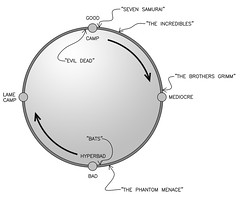
Here's how I recall it, more or less2. In the AV Club's review of the straight-to-video Bats, the reviewer3 posited the existence of a pseudo-cyclical organization of movie quality. (See Figure 1.) As near as I can tell, this was the birth of the hyperbad concept.

Hyperbad - a diagram.
Figure 1.

At the top, we have "Good," which, in general, is what a movie wants to be. From there, moving clockwise, movies pass through "Mediocre" on their way to just plain "Bad." Simple enough, right? I think it's safe to assume that the majority of movies fall somewhere within this range. I realize that my examples are a little sparse, but I'm finding it a lot more difficult than expected to think of mediocre films. They just have no mental staying power.

Sometimes, though, a movie is so bad it's good. They're "Camp." Not always intentional, but a long sight better than plain bad. Not all of them have enough momentum to make it all the way back up to good, but aren't entirely bad. They're just sort of "Lame Camp," the mediocrity of so-bad-it's-good, of the folks aiming for irony but trying too hard. Think teen sex comedies4 at the low end, Bruce Campbell at the top.

Then, of course, we continue along the circle, back to bad. It's a rare film that has this kind of exceptional awfulness, the sort of failure on so many fronts that catapults beyond the so-bad-it's-good of "Camp" to "Hyperbad." This is the sort of topsy-turvy place where normal adjectives just won't do. This is the land of Bats and Frankenhooker and other films that make you demand your money back from the clerk at the rental store. The land of Alan Smithee.

* * * * *

1Due to either excessive alcohol consumption or, more often, sleep deprivation.

2I've fleshed it out, and the picture's mine. But this is the essence of it.

3I'm assuming Nathan Rabin, as his name's on the review as it currently stands. But since I remember a portion of the review that no longer exists, we know this assumption could be wrong, too.

4You know. The ones starring twenty-somethings as teens, that feature no sex, and aren't particularly funny, especially once the pop-culture buzzwords have lost their popularity.

27 June 2006

Behold: Fanny the Roborat.

Chicago.

Hooray! Fanatical Apathy got an upgrade! Or a facelift. Well, it's something snazzy-looking.

Best of all? Adam Felber's added in a few other bloggers, including Mo Rocca and Fanny Roborat. Fanny would be the official FA mascot, as inspired by this story of science gone mad. Seriously. This is like some kind of B-movie setup. The next step, I think, involves massive amounts of radioactivity1, resulting in giant monster robot rats that destroy much of downtown Akron before pseudoscience saves the day. Or possibly Godzilla. He hasn't been around much lately, though.

And speaking of city-smashing excitement, I finally got around to seeing The Incredibles this past weekend. It's a shame Brad Bird hasn't directed more throughout his career - even his stint on "The Simpsons" was primarily as a creative consultant - because he does such wonderful work. Moreso than the previous Pixar features, this felt like a complete film.

Not that the others2 weren't wonderful, but they felt like kids' movies brought up to a level of sophistication where adults could enjoy it. The Incredibles felt more like a movie intended for adults, but which happened to be just fine for kids. Issues that wouldn't mean much to young'uns - like marital infidelity - are touched on in more subtle ways that zip over their little heads. And the usual superhero clichés were tweaked or contrasted so wonderfully with the mundanity of real life, and it was genuinely a relief from the big, mindless action flicks.

Among the points that cheered me the most:
  • The juxtaposition of the super and the mundane. Bob's and Helen's problems require the same sort of gentle relationship maintenance as anyone else, regardless of their crime-fighting superpowers. Bob's put on a lot of weight in middle-age, past his glory days, like every ex-football player you've ever seen. And so on.

  • Edna Mode's vehement opposition to superhero capes. Sure, they look snazzy on the comic book cover, but they're pretty silly in most cases. Batman's an exception, but one of the few. And Brad Bird as Edna is just delightful.

  • Superheroes with previous engagements. It's so rare that a superhero just lets the criminal go because he's got something more important (that isn't some other, more impending, world-threatening disaster).

  • Well-chosen voices. No one seemed bigger than their characters, which is the unfortunate norm these days. Until the credits ran, I was expecting (and hoping) that Frozone was voiced by Phil LaMarr. Not that Samuel L. Jackson didn't do a find job, but I'd love to see the real voice talents get bigger roles. But Craig T. Nelson? Sarah Vowell? Excellent, unexpected choices.
* * * * *

1Possibly from outer space.

2Excluding Cars. Haven't seen that yet, so no comment.

26 June 2006

Strawberries and Shivers.

Chicago.

It feels like this past weekend was all strawberries, all the time. In actuality, it was probably only about twelve hours of strawberry-intense activity. So, hey, not even half of my waking hours.

Saturday morning, we sold (if I heard right) sixty-three flats of strawberries. At ten pounds each - eight quarts in a flat - that's a lot of strawberries. Most went away in one- or two-quart sales, whittled down with frequent tastings. I was a little wary of the sampling berries early on, when folks would eat one and keep on walking. Then Paul arrived with a pallet, and things picked up. We were able to convince plenty of passers-by to buy some berries after tasting, in part because they tasted so good, in part because it was clear we were proud of what we had to sell.

It genuinely helped to have certified organic berries. Locally grown1, too. People weren't concerned about eating them without washing, and there's no potential for a pesticide-influenced taste. Try some conventional berries alongside, and the difference is clear. Taste them against some conventional berries shipped unripe from California, and it's not hard to consider waiting until real berries are available again next year.

Even before tasting this year's crop ourselves, we knew that JenEhr would have great berries. Sharon and I picked five or six pounds last year, and I trust Kay and Paul for quality. We've tried their chickens and produce, visited the farm, and gotten some respectable backup from folks such as Tory Miller, Odessa Piper and Therese Allen. So, even though their hand-weeded organic strawberries may cost more than the average conventional U-pick, it's still our top choice. Besides, I don't think $2.25 per pound is at all unreasonable for organic berries.

Sunday, then, was strawberry U-pick time. Barely ahead of the rumbling thunderstorms - we could see them blackening the western horizon and marching closer - we made it through the patches with over thirteen pounds of berries, scattered rashes along our forearms, and a variety of red stains on hands and clothing.

The stains were only compounded by the jam-making session that directly followed. Ripe strawberries won't stay good through the week, and there's only so many one person can eat fresh.2 And though strawberry shortcake is indeed wonderful, I adore strawberry jam. In addition to being a wonderfully concentrated version of pure strawberry that plays up the deep notes, it keeps forever (or until next June, assuming we don't eat it all first). It's great with pancakes, waffles and crepes. It's a quick and easy way to make sorbet. Or for sweetening iced tea. And when I need an occasional sugar fix, a spoonful of jam'll do it for me.

Not candy or chocolate or any of the usual suspects. I've got to go the Russian route.

So I stuck around long enough to get Sharon through the bulk of the jam-making process. In other words, I made a mess in the kitchen and left before cleanup time.3 By the end of it, I was thoroughly splattered with red juice. At first glance, you might think I'd spent the day butchering animals.4

Speaking of blood and gore: next weekend, the Orpheum (in conjunction with Four Star Video Heaven) will be showing Shivers5, David Cronenberg's first full-length feature. It's about parasites that turn people into killer sex-crazed zombies, full of really disturbing scenes and low-budget special effects. It's part of their "Summer Camp" series of films: "the under-appreciated, oft-forgotten, and wonderfully awful". I don't think I'll be able to catch it - neither showing happens to be at a time I can get there - but I'm dying to see it. I mean, what could there possibly be about a Cronenberg-zombie-sex-horror film produced by Ivan Reitman6 not to like?

* * * * *

1Everything at the DCFM is local, in that it's grown in the state of Wisconsin, and there's a limit to how far vendors can be from Madison and still consider the trip worthwhile. Some shoppers - tourists, I'm guessing - aren't aware of this.

2I hit that limit in the field, per rules one and three of the JenEhr U-pick system. Rule one: eat a berry before you pick any to take with you. That's the only way you know you'll be happy with them. Rule three: eat your fill while harvesting, so you won't be tempted to eat and drive at the same time. Little kids leave the farm looking like extras in a George Romero flick.

3I feel rather guilty about this, but I didn't have much choice.

4Except, of course, for the fact that strawberry juice dries bright red, whereas blood dries black. I realized this on Saturday, when different red splotches dried in different colors.

5Also called They Came From Within!, which is so much cheesier. But what would you expect for the American release in the '70s?

6Of Ghostbusters and Stripes fame, of course. Also Twins, which is why Cronenberg's masterpiece was re-named Dead Ringers.

30 May 2006

Memorial Day weekend.

Madison.

The long weekend, and now it's back to work. That said, it was one hell of a busy three-day weekend, loaded with all sorts of fun activities.

Saturday
Saturday morning was my first morning working at the DCFM, the farmers' market on the square. Aside from being a beautiful and sunny day, it was a useful learning experience1:
  • Apparently, I know enough of the vendors well enough that no one thought it unusual that I was walking around with the farmers setting up their stands at quarter past six in the morning. I don't know if I should be bothered by this or not. At the very least, it coincides with the fact that Sharon and I tend to get all sorts of free stuff, goodies in short supply hidden under the counter (as it were), etc.2

  • I assume this to be more or less unique to this particular market - due to its size, location, and the fact that everyone mentions it to tourists and out-of-towners - but I noticed very distinct waves of shoppers throughout the morning. A less extreme example of this must occur everywhere, but here's what I witnessed (and, honestly, had sort of expected):

    1. The first wave.3 Since the market is so large, and so well established, there's a distinct hierarchy based on seniority. The longer a vendor's been coming to the market - along with several other factors - the better a location they get. After enough time, they get a fixed location, and can set up their stand at six. The remaining vendors walk around, stake out a spot, then set up half an hour later.

      The shoppers of the first wave make their way around while vendors are still setting up. They're a scattered bunch, and include a number of vendors themselves, like Dorothy Priske. Since she and John can set up their stand earlier, she has a chance to do their shopping before the crowds arrive, an opportunity to chat with the other vendors. All of these folks know exactly what they're looking for. They know who has what, and move along with a speed that's impossible once the crowds form.

    2. The second wave. This is the wave I like to be in. Though these people may not know exactly what they're looking for, they're very open to trying new things. Though they may be specifically hunting lettuce, they'll happily taste a bit of arugula, then probably pick up some to take home. They ask questions, they're interested to know what's new this week and what'll be coming up soon. A fair number of them know that farmers by name, and want to say hello.

    3. The third wave. These folks look as if they're new to the market, and a number probably are. They don't have regular vendors they look for, but slip to the side because they've spotted red-leaf lettuce, or strawberries, or something that looks unusual. New things make them apprehensive, and you can never be sure if they'll actually try the swiss chard. Some will, while others will just set it back down and apologize. "Maybe next week," they'll say.

      At this point, the market has become seriously crowded. You no longer walk around the square at a normal pace, but shuffle and walk in intermittent spurts. Some stands - particularly those with cheese curds - become bottlenecks. The grazers begin to appear: the shoppers who taste samples and never buy. This rubs me the wrong way.

    4. The fourth wave. Here come the tourists. They arrive after all of the best stuff has been sold, though they're the least likely to buy any of it, anyhow. These shoppers are looking more than buying, and tend to frequent the bakeries and cheese stands, in massive hordes. Their numbers swell immensely when another tourist draw is in town: a football game, say. They're likely to be frightened by anything more exotic than lettuce4. It's a little depressing. Those shoppers who overslept, or haven't realized that the best goodies disappear early, get stuck here, and inevitably sigh when we have to tell them we've sold out of various items early on.

      By this time, the crowds can only shuffle past. Severe boredom has set in for some - usually middle-aged men, who appear to have been dragged here by their wives. The "salmon" start becoming a regular feature at this point. To explain: the market crowd moves around the square in a counterclockwise direction, just as the one-way streets that border the capitol run. Trying to go the opposite direction is a slow, tedious process of bobbing and weaving, because the rest of the crowd fills the sidewalk completely.

      Another irritating feature of this wave is their shock at the prices of what we're selling. I don't know how to get through to them that the seemingly cheap food at the supermarket has all sorts of hidden costs - economic, yes, but especially social, environmental. The prices you see at a local market, especially one as large as the DCFM, reflect the actual costs of providing food, of supporting the people who farm the land. They're severely underpaid as is, and to suggest that two dollars is too much for a head of lettuce reflects an uninformed worldview. I'm tempted to be angry at these people - and if it's a particular person who should know better, I am - because they say, through their actions, that my friends don't deserve a decent income, don't deserve to raise their children in a safe, comfortable environment... etc.

      These farmers work harder and longer than virtually anyone else walking around that market, and not a single one of them will ever be wealthy because of it.

  • Being a regular at the market means I've become a good reference point. In the past, I've been asked for a second opinion for a customer at Fountain Prairie or JenEhr Family Farm. Unsure of what to buy, or what to do with it afterwards, some customers like to have a little reassurance, or maybe a different way of using it. That said, the Priskes sent along a customer to find me at the JenEhr stand, which was suprising and hilarious. A young guy - looked like a college senior or recent graduate - and his girlfriend (I'm guessing) bought one of the cured, smoked hog jowls from Fountain Prairie. John and Dorothy sent him over to me, to give him some idea of how he might be able to put it to use.

    He seemed pretty open to suggestions, so I'm pleased. I'm not sure how they got him to buy it in the first place. I think he'll enjoy it.

  • Working with someone cool - Steve, in my case - makes the long morning feel good. It's not like we were chatting all morning long, but we managed to tag-team pretty well, keeping the table stocked, setting up and breaking the stand down with a minimum of fuss. We worked pretty well together, and that made it all run smoothly.

  • Kay trusts me more than I'd expected. From the start, she put me in charge. That included setting up the stand, which seemed like a big step for my first day working with her. It worked well, I think, because I didn't set things up like she normally does on autopilot. (Which is what she wanted me to do.)

    She and Paul like to arrange vegetables in bands of contrasting colors that flow down the display table. (Beneath the tablecloth, we have a set of low crates to give an upper tier at the back.) It's definitely eye-catching, and a good attention-grabber. I tried to do something a little different, with a more fluid layout. Since we didn't have much asparagus, for example, it became an island surrounded by spinach and arugula. As the asparagus disappeared, we filled in that space with the other greens. Since it had never been rigidly linear, this didn't look like a mistake. We also used some colored baskets, set upside down, to lend contrast.

  • Breakfast burritos from A La Cart are excellent. I wholeheartedly recommend.
The other significant thing that happened on Saturday was an eventful trip to Four Star. They've done some serious housecleaning, so I ended up buying four new DVDs: Richard Linklater's Waking Life, George Romero's Dawn of the Dead, David Cronenberg's A History of Violence, and Sam Peckinpah's The Wild Bunch. Violence galore! But (with the possible exception of The Wild Bunch, which I haven't actually seen), these're films that use violence to comment on our society, rather than in your typical action flick - like X3, which I'll get to later.

We also rented Terry Gilliam's The Brothers Grimm, which was enjoyable enough as action/comedy fluff, but rather short on the usual Gilliam-ness. I can only really recall one scene - one shot - which struck me as true Gilliam: Jonathan Pryce, the French general, is greeting his assembled dinner guests, all various dignitaries and such. The camera cuts from a close-up of Pryce to the table of guests, which stretches off to infinity in a monstrously cavernous space, with a perspective that's jarring. Drain it of color, and you'd think he'd clipped this shot from Brazil.

Other than that, it was disappointing. I know there was a lot of Hollywood controversy and a lot of hands in the pot, and it feels that way. Given the premise, and Gilliam's love of fairy tales and the grotesque, there was a lot of potential. Still, if you treat it as a fantastic action film and assume some anonymous director, it's well worth a rental.

Sunday
The weather's been quite warm lately, and with any danger of frost past us, we planted our tomato and pepper seedlings in the garden. Then spent a good hour digging out quackgrass rhizomes that had crept in from the neighboring plot. The next plot over has been rototilled, so I'm pretty sure it'll erupt in quack before the end of the season. It's an insidious weed, filling the garden with its underground root network. Even the littlest piece of that root left in the soil might come back to life.

The worst part - and I'm afraid that our neighbor may run into this - is that you can't get it out if you've got plants in the garden. Tearing out the quack means you'll have to disrupt everything, so you spend the growing season shearing it off at the ground and hoping it doesn't spread.

That night was Nick and Simone's wedding reception. Like Sharon and I, they'd gotten married well before throwing the reception party, so - even though there was a brief renewal of vows - it was essentially a big party. On a farm out in southwest Wisconsin, in the middle of nowhere. Since all wedding receptions share certain cultural references, I'll just point out a few random things:
  • The weather was beautiful, and I can't stop thinking about how lucky we were on that account. Thunderstorms have swept through frequently in the past few days, but not that night. We even had a good, constant breeze from the south (where we could watch a wind farm in the distance) that kept all of us in ties and jackets from keeling over in the summery heat. Once the sun set, it was lovely simply standing out in the night air.

    This is a danger of the outdoor wedding, especially since the planning is done so far ahead of time. I've got to believe that our good fortune was a great relief to Nick's frazzled nerves.

  • Nick's parents brought an alarming quantity of palincă - Romanian plum brandy - from Bucharest. Double-distilled, it's strong stuff. It reminded me a lot of grappa, with a clean flavor with hints of vanilla and nuts, among others. Most didn't care for it, but I enjoyed a little glass.

  • Nick's old roommate and her boyfriend brought a keg of homebrew from Minneapolis. It was a wheat beer, but more like a light, slightly cloudy amber ale than a hefeweizen. It was a wonderfully refreshing cool drink, with such a small amount of hop bitterness that you could probably drink it like iced tea.

  • High beam headlights are a wonderful thing. There's little opportunity to use them here in Madison - and zero in Chicago - so it was a little thrill to be able to flip them on out on the back roads of Iowa County.

  • Nick and Simone, of course, looked like a wonderfully happy couple. No surprise there. Now that the whole thing's past, they can settle back into a much less stressful existence, and that can only be a good thing.
Monday
Memorial Day, and what better reason for a near-impromptu grilling party? Paul Johnson's back in town, that's what.

We didn't think of it until midday Sunday, so no one was really prepared, including us. No matter. We had enough food to grill up burgers, mushrooms and sausages, along with some potatoes. Add in a salad and whatever other odds and ends other folks had - beer, mostly - and we were good to go.

Jared brought along a six-pack of his homebrew batch, and the general consensus was positive. I think it needed a little more hop backbone to it - it was a little sweet - but not bad for a first attempt. Besides, that's not his fault. I could tell from the recipe in the kit that it wouldn't seem like enough to me. But it's certainly drinkable, and good served ice-cold beside the grill, so I doubt those two cases'll last very long.

Paul also brought along a pumpkin pie, to finally fulfill his outstanding obligation to Sharon. Their bet involved some strange and insignificant bit of math arcana, and Paul, in losing, needed to bake Sharon a pie. Addington, whose house he was staying at, happened to have a can of pumpkin and a can of sweetened condensed milk at his place. Thus, they decided to bake a pie. Successfully.

After gorging ourselves and melting in the heat and humidity, a few of us decided to go see a movie. As I have no interest in seeing The Da Vinci Code5, we checked out X-Men: The Last Stand. I'd all read the reviews, and didn't expect much other than a dumb action flick. Expectations adequately met, I guess. It sure didn't seem like it needed the big screen, though, and that's a depressing thought. When you think you'd get as much enjoyment of the eye candy on a TV, that says something's not quite right.

It did make me think, at least. Mostly by omission, rather than by raising significant points, but here goes:
  • The whole allegory of homosexuality pretty much disappeared. There was sort a token veneer of "mutant = racism" or "mutant = homosexuality", but it didn't go anywhere. The only conflict derived from it was used to further the plot. No exploration, no dawdling over characters' feelings, no philosophical discussion. It's not a necessary thing to have, but it's so ripe - in the context of the film, in the context of our current society - that it's shame it's not there.

  • Same goes for character development. There wasn't any. A few miscellaneous scenes hinting at romantic rivalries spliced here and there, but there was no development along those lines. Of all the major comic book series, the ones most of us non-comics folks recognize, X-Men is the most like a soap opera. Where's the melodrama? As it was, it was hard to really care about any of the characters. Any emotional involvement had to carry over from the two previous films.

    A glaring example of this is Angel. He starts out so well - a young boy trying to cut the mutant wings sprouting from his back - then resurfaces for a few very brief moments as a walking cliche. Flips out when he's restrained to have the "cure" injected, then bursts out of the window and onto the winds. He swoops through the air to save his father, falling to his death. He steps into the Xavier Institute to start a new life. Who is this guy? The movie doesn't seem particularly interested in him. He's like a MacGuffin with wings.

    Along the same lines: pretty much all of the mutants Magneto conscripts. Names? Nah, the movie doesn't bother with those. They're mostly special effects pawns. When they die, we don't much care one way or the other.

  • Corny one-liners? Either leave them out, or go whole hog. The two extremes work. Compromise doesn't. The half-assed approach to camp - just like the tepid interpersonal relationships - doesn't cut it.

  • Bizarre logical conclusions. If Juggernaut is so threatening that he needs to be completely immobilized, locked into a closet, and secretly driven around 24/7 in the back of a tractor trailer, why isn't he simply given the mutant "cure"? He's a dangerous psychopath. Even in legal prisons, the law allows inmates to be forcibly medicated for the safety of guards, other inmates and themselves. Regardless of where that might stand ethically, you'd think this would have occurred to somebody at some point. At least to mention, if not act upon.

    And there's another unaddressed issue. Secret, mobile prisons? Come on... you can't pull this stuff from the headlines and just let it hang there!

  • Oh, and the violence. So sterile and neutral. Aside from Wolverine opening up in bloody wounds - which seal up more or less instantly - you don't see much of anything. Even as Wolverine carves up dozens of people, and they immediately fall out of frame. No blood, no screams, no nothing. I guess this is more or less normal for summer action flicks, and I'm just disillusioned with that.

    Or maybe it's because the movie failed to address anything else, so I just started latching on to every omission I could. Before we went to see the movie, I was discussing Cronenberg's A History of Violence, which takes the complete, polar opposite tack. Violence, and its impact through the popular media, was on my mind. I think I was offended by the complete lack of blood. Even if there were some - and it were quickly passed over - I'd've been okay with it.

    Characters who die are simply forgotten. Major ones. Cyclops dies at the beginning of the film, and we essentially hear nothing about him until we see his tombstone at the end. It's crazy.

  • And it was so short - ninety minutes or so. All of the things that this film could have used - character development, social commentary, breathing room between exploding setpieces, etc. - sure weren't trimmed for time.

* * * * *

1And a chance to verify a few of my hunches about the whole thing. That being a primary reason behind my decision to start working at the market.

2For a more intense example, check out the "Lunchtime with the King of Ketchup" on this episode from This American Life. I can only aspire to Howard's level.

3The waves overlap and blend, of course, but the distinction is still pretty apparent when you're standing around, watching and talking through the morning.

4Seriously. Some of them bear a distinctly spooked expression when you try to explain that mizuna makes a great salad green. They'll pick up unfamiliar produce as though it were something potentially dangerous, like a live animal.

5Don't want to read the book. Don't want to see the movie. There're enough other books and films I'd like to see that have a much better claim to my time and money. It's not like I'm missing some grand cultural edifice; I mean, this is the sort of pulp drivel you'd expect to churn out for NaNoWriMo or something equally silly and amusingly self-absorbing.