Showing posts with label Design. Show all posts

13 June 2011

The new smoker.

Lewisburg.

It took long enough, but I finally have a serious smoker. No more of those cardboard box shenanigans!1

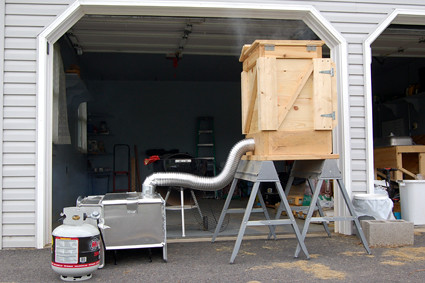
It still looks like a half-assed high school steampunk disaster, though:
Smoker contraption

Never mind that. It works, and works reliably, and if it didn't weigh a ton, it'd be perfect. A firebox, made from food-grade aluminum2, holds a two-burner propane camp stove, each of which has its own cast-iron smoker box to hold the necessary wood chips and sawdust. The heat draws in plenty of oxygen from the apertures at the base, exiting out the duct at the top.

Then it's into the food box:
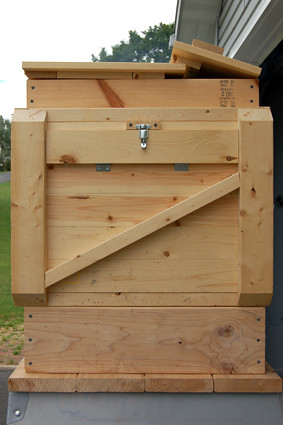
Smoker foodbox

Even split into three separate pieces, this sucker's still heavy. Solid. Imposing to move in and out of the basement.

The base is where the smoke enters, and I can rig this up to include trays of ice for colder smoking, if necessary. Today, after three hours of smoking, it was a mere 150°F inside, which suggests to me that I've got good flexibility in temperature control. Come autumn, cooler temperatures will be much easier to achieve.

The central piece holds the racks for smoked items, as well as rods to hang sausages from. The whole front panel is a door that swings open, with a small window near the top to peek in. Atop that is a two-panel roof that can be opened as much as necessary to get good airflow.

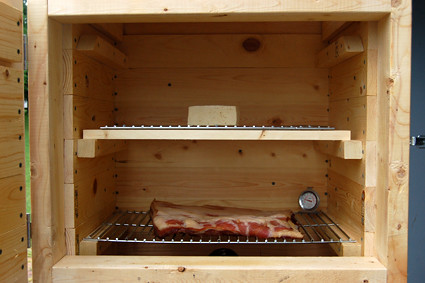
Pig and soybean

Today's test run included some honey-cured bacon and a block of tofu. Really, once you've got it going, you might as well toss in what's at hand. If I'd had my act together, I'm sure I could have packed it full. Kamozawa and Talbot's Ideas in Food is full of suggestions to get things started. I'm already looking forward to smoked tomatoes, peppers, eggplant, apples, and pears, in addition to cured meats and sausages. And, undoubtedly, plenty more.

* * * * *

1Actually, the cardboard box setup was pretty sweet, especially for a tiny apartment. If it weren't so finicky, and prone to waterproofing / wind resistance / flammability concerns, it might still be around.

2Read: Inexpensive sheet pans from a restaurant supply store. Trimmed, riveted together, and sealed with fireplace mortar.

16 May 2010

Deer-free.

Lewisburg.

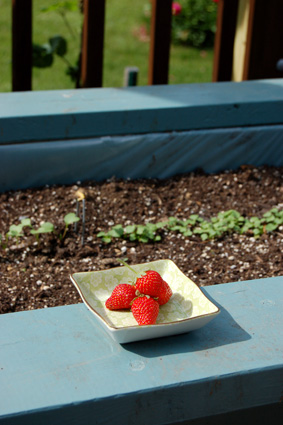
For those who've missed it, it's full-blown gardening season. Around here, at any rate. Gardening + work + bare minimum of effort required to keep dog sane and house from burning down = long days. But it all starts to feel fine once the harvesting begins. We've had a few odds and ends already - hop shoots, which are a bit like asparagus; dandelion and chicory greens; some rhubarb1 - but we're starting to get strawberries:

2010 strawberries

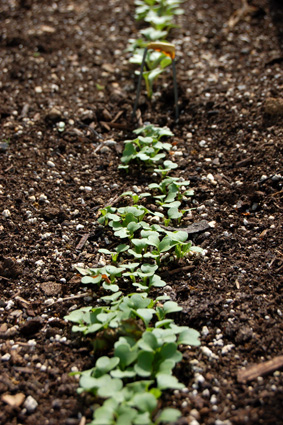
Behind them are the radishes and turnips in the deck-protected planters:

Sprouts

They're tiny, but quick to grow. The downside of planters is that the soil in them is more subject to surrounding air temperature, so seeds here will germinate later than those directly in the earth. The upside, of course, is the ease of harvest and rather effective critter-proofing. If by next year I'm able to construct a set of cold frames, I'll actually be able to put out extra-early plantings of cold-tolerant vegetables to enjoy before the main crops kick off.

That said, I doubt anything can beat the hops out of the gate.

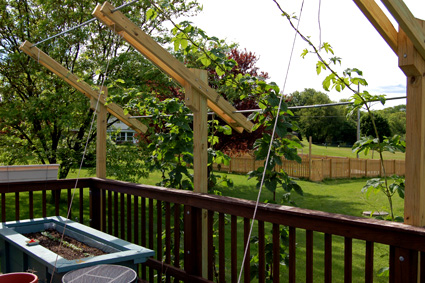
Hops

I noticed shoots emerging at the very start of April. Within a week, I'd managed to cobble together a support structure that now, six weeks later, isn't big enough to accommodate the most vigorous bines. Honestly, though, I was rather busy with the rest of the garden. After all, it's all now in here:

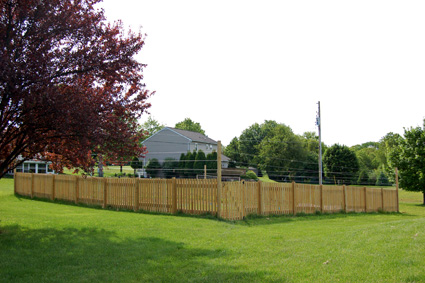
Fence

Though the wire mesh guard at the bottom isn't entirely finished - there's evidence of rabbits getting in and nibbling a bit - and we have yet to stain it2, it's essentially complete. Fifty feet square, four and a half feet tall with deer-deterring cables three feet higher, enclosing eight distinct garden plots (each thirteen feet square) and a central picnic space. Seven of eight plots are currently tilled, with the last half-complete.3 This year's seedlings, beneath fluorescent lights in the basement, are doing better than they ever have before, looking in perfect shape to give us plenty to eat, despite this year's smaller garden.

And look:

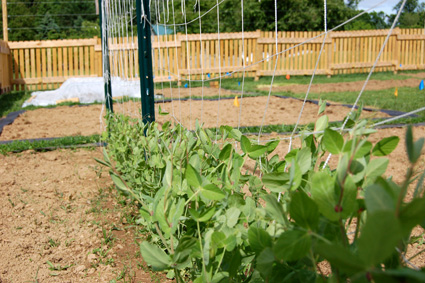
Peas

Peas safe from deer browsing. So worth it.

* * * * *

1Which, as this morning's breakfast can attest, makes for some fine scones. Chop into ¼-inch lengths, toss with sugar, and keep 'em raw. They hold their shape during cooking, but soften up nicely, with their sour flavor intact.

2Enough free time plus two days of rain-free, warm weather seems too much to ask for at the moment.

3In order to keep my head from exploding - it's best, when tackling a major project like a large fence, to maximize its enclosed area and minimize its bill of materials; square is both simple and efficient to construct - the garden is in a new location. So all that ground tilled before? Unused. (Bound for next year's orchard.) Our rototiller? Broken halfway through. Our neighbor's rototiller? Semi-functional, with frustrating carburetor trouble. So it's down to tiller number three to get the job done. Backs and shoulders, for those wondering, are rather sore these days.

08 February 2007

Clip/Stamp/Fold.

Madison.

They're a former incarnation of the zine, a snapshot of the evolution of self-publishing from a time when students - as a whole, in great masses - believed in revolution. The Storefront for Art and Architecture has organized a show of architectural magazines from the '60s and '70s: Clip/Stamp/Fold: The Radical Architecture of Little Magazines 196x-197x. Today's New York Times carries a review, and you can check out a lot of the covers at the Clip/Stamp/Fold site, under the "Magazines" section.

Fascinating stuff. These little magazines, many student-published, often highly politicized, and generally full of idealism, cover a wide range of topics from architectural criticism to satire to discussions of comics as an art form. A large number appear to be European - English, French, Italian, mostly - but there are showings from Japan and Mexico, among others. Arquitectos de México (1969) strikes me as particularly interesting, as a voice of political and social consciousness against the repressive government, only later to be crushed by it.

What stands out, both in Nicolai Ouroussoff's review and in my own experience, is how it's hard to imagine something of this sort, these radical views from within the design community, against the design community, ever sprouting today. As Ouroussoff puts it:
Part of the point here of course is that ideas matter. Even the flimsiest of these magazines were shaped by the crazy notion that design not only was important but could also change the world.
How often do we see architects intent on focusing their efforts to making social change? To making a small but powerful impact to improve the world they live in?

Not every day. One example - the one that usually springs to mind - is the late Sam Mockbee, founder of Rural Studio at Auburn University in Alabama. The program, amazingly, has continued in the five years since his death, designing and building houses and other structures for some of the most impoverished people in America, in western Alabama. It isn't the perfect model for the place of design in world - for one, it relies heavily on volunteer student labor, over a limited time frame, which tightly confines the types of projects that can be effectively taken on - but it's a fine start. It is, if nothing else, an eloquent argument for the ethical responsibility1 of architects, of designers.

In general, though, you don't see that. I don't often see it professionally. The design world, these days, is heavily influenced by fashion, by the flash of brand marketing, the rapid-fire sound bites of television and advertising. Who makes the headlines? Frank Gehry. Santiago Calatrava. "Starchitects". Big names, showing off bold designs. Bold, expensive designs. When I was a student, these were the sorts of heights to which everyone aspired. It was all about design, about form, about, essentially, how cool architecture could be.

I never took any courses in ethics. The subject never came up; it never crossed my mind. A quick scan of three major US architecture programs - Harvard, Princeton, and Yale - doesn't pick up but a trace of the notion there. Harvard has a "professional practice" course requirement, but it's running in a completely different direction, with courses on "Markets and Market Failures", "Advanced Real Estate Development and Finance", and "Public Approvals for Private Development Projects", among others.

So, does the design community just think this isn't an issue?2

I am aware of one school that does consider this an issue: Archeworks. Founded by Stanley Tigerman3 and Eva Maddox, it's an alternative one-year architecture program for people from all backgrounds. They even have a mandatory Ethics and Morality course during the first semester. Still, it's a tiny program, intended as a means of intellectual growth for professionals. And these professionals need to have the same sort of goals on their radar already; it's unlikely to attract those who've never given their ethical responsibilities much thought.

I suppose we have yet to see what direction the design world decides to take in the future. The outlook, it seems, is bleak. Until we see the return of youthful idealism, we can only expect Sam Mockbee and his like to be brilliant exceptions to the norm.4

* * * * *

1I wish to point out, here, that Mockbee was not a religious man, that his notions of decency in design were not buttressed by some sort of religious ethics. Informed by them, perhaps, in the way that religions and other schools of thought influence our cultures, but Rural Studio was, and is, far more open-minded than that. Also worth noting is the distinct regionalism of Rural Studio, the notion that if one is to make a difference, there are plenty of opportunities in one's own backyard.

2Well, that's my guess.

3One of the old guard, who very well might have been behind some of the magazines in the Clip/Stamp/Fold show. He's loud, he's brash, and he'll only take crap from you if you can back it up with good ideas that show serious thought. He's very funny if you're on his good side, and unapologetically blunt if you're not.

4Mockbee was awarded a MacArthur Foundation Fellowship, in 2000, for his Rural Studio work. So, yes, there are people out there who think he might have been on the right track.

10 December 2006

Brakhage.

Madison.

I've completed watching what I believe to be the most bizarre collection of film I've ever seen: By Brakhage: An Anthology, a selection of Stan Brakhage's films released on DVD by The Criterion Collection. It contains, in total, twenty-six films running 243 minutes, but it took me nearly eight hours to make it through all. Every so often - sometimes in the middle of a film - I'd have to take a break. It's intense.

Just to give a brief overview of Brakhage and his work, as I understand things:
  • Brakhage's work is grounded more in poetry than cinema. Though he notes, on the DVD, that he greatly enjoys Hollywood movies, it doesn't appear that he ever made a film even remotely close to Hollywood's aesthetic. He made films, yes, but more analogous to paintings than to any sort of narrative medium.

  • His early films are primarily shots of actual things, though scenes are cut up, overlaid on top of each other - up to four different reels in the case of Dog Star Man - and otherwise garbled. Later, he began painting and scratching the film itself, sometimes over exposed images, sometimes on blank or fully exposed film. In essence, he began creating films without a camera.

  • Most of his films have no sound; he explains that he feels any sound would be a distraction from what's on screen. Sometimes, especially during his longer pieces, I found myself wishing there were something to listen to, but couldn't possibly imagine what would fit with the images I was watching. Some sort of hyper-frenetic John Zorn composition, maybe.

  • Brakhage's films explore, in his words, "birth, sex, death, and the search for God," and he had no qualms about showing deeply disturbing images. Dog Star Man features snippets from the birth of his daughter, overlaid with solar flares and shots of the Colorado wilderness; Window Water Baby Moving is much of the same footage, no longer obscured by other imagery. Then there's The Act of Seeing with One’s Own Eyes, which the DVD prefaces with this warning:
    PLEASE BE ADVISED: This film consists
    entirely of footage of actual autopsies.
    It does. It's both disturbing1 and fascinating. Like when the coroner's thumbprint leaves a dent in flesh, where a living person's body would have sprung back. Or when slicing open the skin produces no blood, just a layer of skin and subcutaneous fat that's drawn back for... whatever they're doing, exactly. With no sound, and a constant shifting from one autopsy to the next, you're left without the sort of context that might let you linger on one, specific corpse for too long. It's eerily disengaging.

  • An experimental icon, Brakhage even took to taping objects to film to see what would happen. The most famous of these is Mothlight, which, like many of his hand-painted films, is as fascinating frame-by-frame as it is at 24 fps. You can see individual frames from a number of his works on Fred Camper's Brakhage website. Seeing them in this format, with frames laid out as they were during the painting process, gives another level of understanding and appreciation for the work.

  • Regardless of what you think of the overall craziness of Brakhage's work - and there's craziness aplenty - it's worth noting the amount of effort and craft that went into this. When working directly on (usually 16mm) film, he could only complete one quarter- to one half-second's worth of film in a day. Some of his later works were several minutes long, representing a phenomenal amount of work for something that, until the creation of this DVD,2 flitted past in a barely-recognizable instant. Some of them, particularly those in Nightmusic, are absolutely beautiful.
Suffice to say, it's a lot collected onto two DVDs. It's not the sort of thing I'd want to watch over and over again, but I'm glad to have seen it. I'm still not sure what to make of it all.

If you'd like to see an example, YouTube has a few Brakhage films. They're a little lackluster - the digital compression makes a blurry mess of the frantic eruptions of color - but it's enough to get an idea. See The Garden of Earthly Delight for a series of montane flora taped to a reel of film; The Dante Quartet is a good example of his painting technique.

And, speaking of abstract, modern art, I went to see the current exhibit at the Madison Museum of Contemporary Art on Friday, Alyson Shotz: Topologies. The artist was there to discuss her work, and a group of math grad students went over to check it out. (Then we went out for drinks.)

The exhibit had good and bad. It's contemporary art, which, free from the rigorous forms and styles of traditional arts, means it's open to a wide range of interpretation. Ms. Schotz admitted this much herself, explaining that she often creates a piece, then tries to determine what it means to her. Okay. Works for me.

Except that she sometimes had extra layers of meaning that weren't apparent, which she used as the crux in understanding the work. My general thought is that if, say, you need to know that the work consists of hyperbolic paraboloids that may or may not represent the shape of the universe in order to see it as more than a pretty pile of crumpled paper, perhaps that ought to be noted beside the little plaque bearing the work's title. It's one thing to be able to seek out a deeper, multilayered, more personal appreciation of a work of art, but I'm less than thrilled by art that's intentionally obscure.

Even that I can look past, brushing it off as plain pretension, a sort of myopia imposed by focusing on one's own work all day, every day.3 But there were two specific things that dug under my skin at the exhibit.

One: Ms. Shotz admitted to having an assistant who helps put together a lot of her work; on at least one piece, she said, her assistant had done all of the work. The assistant's name was not noted anywhere.

Two: The level of craft on most of the works was shoddy, at best. Regardless of the artistic merit, several of the pieces were just... poorly made. I'd be embarrassed to have my name on a piece like Cocoon. (Detail here.) Given the delicacy and translucency of the materials used to construct it - glass beads and fresnel lenses - she chose to use staples to hold it all together. Metal staples. The sort you might use to hold together your construction paper projects in elementary school. And the Forced Bloom series, while interesting enough in concept, are examples of genuinely poor computer graphics skills.4

Allusion of Gravity was nice, though. Note: it's more impressive at a distance.

* * * * *

1Not the most disturbing film I've ever seen. I've been mulling over this, and I think the award - at least, of the films I've seen - goes to The Battle of Algiers. Not Cronenberg's most visceral work, or George Romero's zombie films, or anything that looks like a movie. The Battle of Algiers looks almost like a documentary, which is why the vicious scenes of torture - brief, not bloody, but looking entirely real - turn my stomach. Even more so is the scene, just before the torture, where FLN bombs explode in the bleachers at the horse races, a place filled with wealthy French spectators. An enraged mob converges on a small Algerian boy selling concessions, beating him unconscious until the police lift him out. You don't see any of the explicit violence, as it's hidden by the bodies of the mob, but the scene is so stark and brutal that I find it extremely difficult to watch.

2As near as I can tell, the Criterion DVD is the first time Brakhage's work has been made available digitally. The greatest benefit of this is that you can step through it, frame by frame, examining each as you would a painting in a gallery. Indeed, it's very much like a collection of thousands upon thousands of unique works of abstract art.

3This is a special talent that many architects (and related designers) have, in my experience. It most often occurs when they begin to think they're designing spaces for aesthetics first, and practicality second.

4I refuse to send out any graphics work that looks as choppy about the edges as those pieces do. She's a professional, in a field that should have a finer attention to detail than mine.

31 July 2006

The Lorenzo de Medici of Avondale?

Chicago.

For those stuck in Chicago during the heat wave, it may be of interest to swing by Hot Doug's to see their new "gallery." From the Hot Doug's web page:
Hot Doug's, the Lorenzo de Medici of Avondale, is proud to sponsor the permanent installation of mural paintings by Louise Baker, WonderWalls
OPENING RECEPTION:
TUESDAY, AUGUST 1ST, 1pm - 4pm
There will be cookies!
Let's repeat that last bit: There will be cookies!

Plus, they have air conditioning, which is something I'm lacking.

TimeOut Chicago has a brief blurb about the murals, should the promise of cookies and pleasant air temperatures not be enough on its own.

16 May 2006

Preliminary thoughts on growth.

Madison.

At some point during last year's NaNoWriMo1, Chris Baty mentioned - in one of his amusing, coffee-fueled pep talks - Bruce Mau's2 "An Incomplete Manifesto for Growth" as an inspirational reference point. It reads a lot like those cheesy, oft-forwarded email lists that I always ignore, but feels like the product of experience and critical thinking, rather than the vapid filler of Hallmark cards.

Mostly, anyways. A few that strike me as worthy of further consideration:

2. Forget about good. Good is a known quantity. Good is what we all agree on. Growth is not necessarily good. Growth is an exploration of unlit recesses that may or may not yield to our research. As long as you stick to good you'll never have real growth.

Maybe this was just how he thought eight years ago, but good no longer appears to be what we all agree on. Nor, as corollary to that, a "known quantity." It is, I believe, a highly subjective matter, but that's not what I'm getting at.

I'm concerned about growth because of the vagueness of it. I like to think that Mau is referring to development, to evolution, rather than to the process of enlarging. Given his design focus, this would make sense, but it's not clear. Especially given the way capitalism seems to work - the Wal-Mart effect - by rewarding bulk and power; this sort of growth abandons good. To foster growth at the expense of good, with no system to balance it, is dangerous. We need to retain the ability to rein in growth that has become harmful.

14. Don’t be cool. Cool is conservative fear dressed in black. Free yourself from limits of this sort.

I really like this one, especially coming from a man whose own life's work is deeply rooted in style. I've never had much of a knack for cool. In the design world, cool often supplants good sense, and it's always irritating.

That said, I don't have much to add. I think there's a crucial difference between those who are cool because they're pioneers, being bold and different - the minority - and those who are cool because they're mimics. The difference is that the former aren't trying to be cool; they're evolving and have the confidence to pull it off. It's not always a good thing. Sometimes it's naught but fluff and style. But it beats being a stylistic copycat.

22. Make your own tools. Hybridize your tools in order to build unique things. Even simple tools that are your own can yield entirely new avenues of exploration. Remember, tools amplify our capacities, so even a small tool can make a big difference.

The key point here, I think, is that tools "amplify our capacities." This is not the same as an object we use to complete a certain task - which seems to be the common perception of a tool - but there is some overlap. I think our understanding of the role of tools, of technology, is better informed by this notion of amplification.

We use tools, especially specialized ones - think pneumatic nail guns, or lawnmowers - to accomplish certain specific tasks. Tasks that we can't do without them, at least in quite the same way. In a practical, mechanical sense, they simply redirect our energy into forms and directions our fingers can't manage. In a design sense, tools are objects or processes that enable us to bring an abstract vision closer to reality. Or that reality closer to our initial conception of it. In either sense, tools are simply "finglongers" for our skills and abilities.

Mau also notes that we should "hybridize" to create something unique. This is like a feedback loop through the tool, using our skills to enhance the tools to further develop our abilities. I think we forget this, but more on that under the next note.

29. Think with your mind. Forget technology. Creativity is not device-dependent.

I don't think we should forget technology, but that we should learn to avoid relying on it. In particular, I think it's dangerous to rely on technologies that we don't fully understand - computers and cell phones come to mind, as both poorly understood and ubiquitous. When technology is a black box, placing our well-being in it is a remarkable leap of faith, and one that most of us do every day.3

I'm not advocating Luddism, in the sense of declaring all technology evil, of reverting to some benchmark in human history. The short and brutal existence of stone-age man (or of the Renaissance, or whatever), stripped of any romantic sheen, has all of zero appeal. But if you were only permitted to use a cell phone, or a microwave, after you were able to understand how it works? It's not difficult, and it makes such a difference in how someone uses that tool, in respect for the technology. In using it in the way it's supposed to work. In, as Mau puts it, hybridizing the tool to extend its, and our, capabilities.

In the same vein, I think that we need to better understand the networks, the systems that support us. Consider Michael Pollan and his attempts to trace a McDonald's meal back to its source, and his point - and not his alone - that cheap food is remarkably expensive, in ways that aren't easily quantifiable in dollars. Consider the American dependency on foreign oil, and its connections with terrorism, human rights violations, etc. Not knowing these things - not attempting to know these things - puts us in the position of being at the mercy of the black box.

Freedom equals responsibility. We all know this.

33. Take field trips. The bandwidth of the world is greater than that of your TV set, or the Internet, or even a totally immersive, interactive, dynamically rendered, object-oriented, real-time, computer graphic–simulated environment.

"But this is HDTV! It's got better resolution than the real world."

It's so obvious, and yet...

What Mau doesn't say, directly, is not to simply get out and see the real world, but to pay attention. Look at the details, the subtle changes and differences in the world around us. The level of detail out there is always more than we can fully understand. You can't look too hard, too close.

35. Imitate. Don’t be shy about it. Try to get as close as you can. You'll never get all the way, and the separation might be truly remarkable. We have only to look to Richard Hamilton and his version of Marcel Duchamp’s large glass to see how rich, discredited, and underused imitation is as a technique.

Imitation rocks. Seriously.

The clearest example of this, to me, is cooking-related, but it works in all sorts of endeavors. And the critical distinction is that it's not copying. Not plagiarism, passing off someone else's work as your own. It's attempting to recreate someone else's work, using your own skills and understanding to hit that target. It's something to reach for.

Nearly everyone who cooks does this, and I think it's an example most of us can relate to. We try to recreate the dishes, or a specific meal, that mom or dad used to make, and it's rarely the same thing. This is disappointing at first, because it's just not the same. Eventally, though, most of us make it into something that is distinctly our own, an evolution from the chicken pot pie that mom always made into the chicken pot pie that I make. I like mine. It's very much mine, with all of the hallmarks of my cooking style, but clearly an extension of the way mom does it.

It began as imitation, but allowed me to find my own style, as it were. Think of imitation as part of the process, not the destination, and you see it as another powerful tool. An underrated one, at that.

38. Explore the other edge. Great liberty exists when we avoid trying to run with the technological pack. We can’t find the leading edge because it’s trampled underfoot. Try using old-tech equipment made obsolete by an economic cycle but still rich with potential.

This is the mantra of the small-scale farmer, the guiding principle of sustainable, organic, local agriculture. This is Chuck Jones' animation, the simplicity of minimalist, hand-drawn cartoons that are more expressive and engaging than any CGI razzmatazz, ever. This is craft beer. This is Richard Linklater's Waking Life, digging Rotoscoping out of the cinematic graveyard and showing off its potential. This is the farmers' market instead of the supermarket. The soundtrack to O Brother, Where Art Thou. And so on.

This is the left field in which brilliant ideas are born.4

* * * * *

1National Novel Writing Month, of course. The maddening and thoroughly exciting race to write a 50,000-word novel in thirty days.

2Bruce Mau is a graphic designer based in Toronto. He's a pro-design sort of guy, who sees design as a powerful tool for change. His Massive Change exhibition is gearing up to hit the road, starting off at the MCA in Chicago in September. Design may not be my preferred tool for effecting change, but I can appreciate the need to understand its impact in the world today. I also think that those who do choose design as their primary vocation should be aware of the total import of their work.

3Like, say, computers and the internet. Or automobiles. How many people out on the road, at this moment, can actually explain how it is that their car propels them forward? How many of them know that the prized "new car smell" is the potentially toxic off-gassing of the materials making up their car's interior?

4And, yes, lots of crummy ones, too. Wheat, chaff, etc., etc.

23 February 2006

Love Craft. Not Kraft.

Madison.

I spend the bulk of my days - weekdays, workdays - surrounded by people enamored of "Art" (capital A). I'm unclear on exactly what they mean. This may have something to do with the fact that every building products manufacturer tries to exploit the notion of art in their advertising, their corporate slogan, wherever. I may suffer from a stunted imagination, but I can't really make the associative leap that sort of marketing requires.

Maybe I'm supposed to watch more TV.

There seems to be this loose definition, this vague understanding of what we mean by art, that fuels this mindset. We speak of processes in euphemisms like, "I've got it down to a science," or "There's an art to it." From what I can gather, the former means that the process can be broken down into a series of steps, a convenient line diagram that states, "If A, do B. If C, do D." Sometimes you're allowed to personalize things, but it's pretty much like a mathematical function: each set of inputs determines a specific output. In theory, you could just write down this step-by-step process, and anyone could follow it exactly. (Not exactly science, since it doesn't involve the continual questioning and testing that are the hallmark of the scientific method, but I'm not getting into that today.)

The latter means, more or less, that it requires a sort of intuition - gained through experience, talent, doesn't matter - to get the appropriate end result. Chances are that you have a variety of different things you could end up with, each having a varying degree of success. For some, this is the perfect excuse to inflate their own egos, a sort of proof that they've got the chops and you don't, neener neener. Maybe it's not always so overt, but I think I see it when designers are listed for project awards. I'm fortunate to have a firm that respects individual designers enough to give us all our names beside the images, but I realize that's a rarity.

I don't feel like picking on a particular person today, so I'll use the term 'Starchitect' as a stand-in. Whenever we see grand images of some new, flashy piece of architecture (completed or design-in-progress), they are accompanied with Starchitect's name. Sometimes it'll include the firm, but most references will point to a single individual. The team responsible for executing the design - which often includes other architectural firms in the case of particularly large, complex projects - barely gets a mention. It conditions us, especially those outside that particular technical field, to think of this as the work and responsibility of a single person. Responsibility it may have been, though even the most technically savvy architect is hard-pressed to understand, in all honesty, the full extent of the design of all the systems in most any sizable building. But work? Hardly. Between the technical expertise, drafting plans and details, writing specifications, and all else, it's truly impossible for one person to do it, let alone in any sort of time frame that prevents a design from being obsolete at completion.

If Starchitect's really a manager, then let's call him that. There's a perception of management folks - not entirely positive, deserved or not - that is not entirely out of place.

This also minimizes the efforts of the manual laborers responsible for turning a bound set of drawings into something tangible. Few designers can do much in the way of manual labor these days. Those who can lay claim to titles like 'master builder' that represent positions straddling the divide between design and manufacture, roles that have been essentially eliminated by an increasingly fractured, specialized system. Not only is each side - design and construction - divorced from an integrated understanding of the entire process, but it promotes a divide that one's own side is always right, an us-versus-them mentality.

Where I think the notions of the master builder and the art (little a) live is craft. Craft, or craftsmanship, is the province of the master builder, the intersection of both design and manufacture. It's the work of the artisan, not the artist, a creative endeavor that involves the craftsman in all aspects. It requires more skill, more effort, more of an investment in the process, but results in something that you can view with a justifiable sense of pride. You can say, "I made that." Although it may not be the best of its kind - there's always someone better - those who understand the effort required in their own craft can respect it, can be impressed.

One doesn't need to build one's own house. This can be as simple as cooking a meal, an example that I think most people can relate to. The more you put into understanding the process - both overall and in all its details - the more engaging it becomes. A homemade meal doesn't need to reflect just one's skills at slicing, mixing and heating food, but can reach as far into other realms of interest as one is willing to go: growing fresh herbs and vegetables; getting to know a farmer who raises the livestock you'll be eating, knowing that the animals are treated well; building a barbecue pit in the backyard; making special, unique containers to give with food gifts. Whatever.

I think craft can be and deserves to be taught. Although there is much to be said for individual innovation, an amazing wealth of knowledge and skill to be learned from those craftsmen still practicing their trades. Slow Food is a good example of a movement trying to keep traditional foods, cooking, and the social nature of eating alive and well. Another everyday example is National Novel Writing Month, though it tends to the idiosyncratic, artistic side. It's still an immensely useful tool to understanding and appreciating writing as a craft.

Plus, it's insanely fun. And isn't that what one's craft ought to be?